
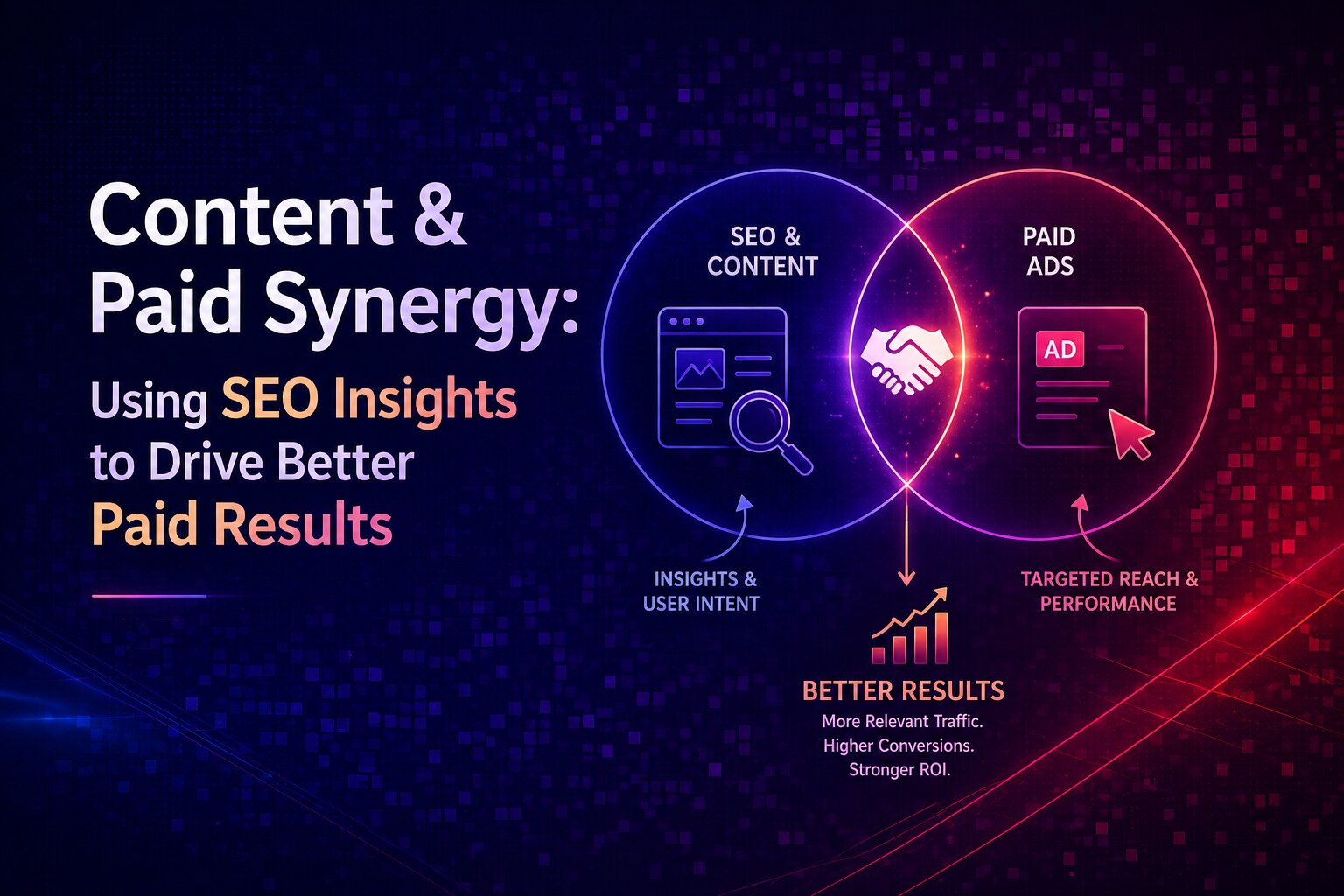
SEO and Paid Media Were Never Meant to Be Separate
For years, SEO and paid media lived in silos.
SEO teams focused on:
- Rankings
- Content
- Long-term growth
Paid teams focused on:
- Bids
- Budgets
- Immediate performance
In 2026, that separation is a liability.
With automation dominating paid platforms and AI reshaping search behavior, the strongest growth now comes from aligning organic insight with paid execution.
SEO shows you what people want.
Paid media lets you act on it immediately.
Why Content & Paid Synergy Matters More in 2026
Modern platforms operated by Google and Meta are increasingly algorithm-driven.
That means:
- Paid algorithms reward relevance and intent alignment
- Organic data reveals intent patterns at scale
- Content performance signals demand before money is spent
When SEO and paid work together, you reduce guesswork—and increase efficiency.
SEO Data Is the Most Honest Market Research You Have
Organic search data reflects unpaid user intent.
People type what they actually want—without being influenced by ad copy or offers.
This makes SEO insights incredibly valuable for paid strategy.
High-Value SEO Signals for Paid Teams
- Top-performing organic queries
- Queries with high impressions but low CTR
- Content that drives assisted conversions
- Long-tail queries with strong engagement
- Informational pages that precede conversions
These signals tell paid teams:
“This is what resonates—before you spend a dollar.”
How to Use SEO Insights to Improve Paid Performance
1. Turn High-Intent Organic Queries Into Paid Keywords
Organic data shows which queries:
- Drive conversions
- Attract qualified users
- Signal readiness to buy
These are ideal candidates for:
- Paid search targeting
- Smart bidding inputs
- Conversion-focused ad copy
Instead of guessing which keywords to bid on, SEO data pre-qualifies them.
2. Use Organic Titles & Headlines to Improve Ad Copy
Top-ranking content often wins because of:
- Strong messaging
- Clear value propositions
- Emotional relevance
Paid teams should borrow:
- Language patterns
- Pain-point framing
- Benefits that already work organically
If a headline earns clicks without ad spend, it’s a strong creative signal.
3. Identify Gaps Where Paid Can Capture Demand Faster
SEO takes time.
Paid fills gaps where:
- Rankings aren’t there yet
- New content hasn’t matured
- Competitive SERPs suppress organic visibility
SEO data highlights:
- High-impression keywords you don’t rank for
- Topics where competitors dominate organically
Paid media can step in immediately—while SEO builds long-term authority.
How Paid Media Data Improves SEO Strategy
The synergy works both ways.
Paid media produces fast feedback that SEO can’t.
1. Paid Search Reveals True Conversion Intent
Not all organic traffic converts equally.
Paid campaigns quickly show:
- Which queries actually convert
- Which audiences move fastest
- Which messages reduce friction
SEO teams can then:
- Prioritize content around proven intent
- Refine informational content toward conversion paths
- Build content that supports high-value journeys
2. Ad Performance Informs Content Structure
If paid ads convert better when they:
- Lead with pricing
- Emphasize speed
- Highlight social proof
Then SEO content should reflect the same priorities.
Paid data helps SEO teams optimize for persuasion, not just rankings.
3. Retargeting Data Identifies Content That Assists Conversions
Paid retargeting often reveals:
- Which pages users visit before converting
- Which content builds trust
- Where drop-offs occur
This helps SEO teams:
- Strengthen high-assist content
- Improve internal linking
- Create better content clusters around revenue-driving topics
Content + Paid in an AI-Driven Search World
As AI search and automated bidding evolve, clear intent signals matter more than channel boundaries.
AI systems learn from:
- Query behavior
- Engagement patterns
- Conversion signals
When SEO and paid strategies are aligned:
- AI learns faster
- Performance stabilizes sooner
- Budgets work harder
Disconnected strategies feed AI conflicting signals.
A Practical Content & Paid Synergy Framework
Step 1: Shared Keyword & Query Review
- Monthly SEO + paid keyword alignment
- Identify overlap, gaps, and opportunities
Step 2: Message Consistency
- Align ad copy with top-performing organic language
- Match content tone to paid intent stages
Step 3: Funnel Mapping
- SEO for education and discovery
- Paid for acceleration and capture
- Retargeting for conversion reinforcement
Step 4: Unified Measurement
- Track assisted conversions
- Monitor branded search lift
- Evaluate total demand growth—not channel wins
Common Mistakes That Kill Synergy
❌ Treating SEO as “Free Traffic”
SEO is insight—not just acquisition.
❌ Letting Paid Ignore Organic Learnings
Paid teams who skip SEO data overpay for experimentation.
❌ Measuring Channels in Isolation
Users don’t experience marketing in silos—neither should reporting.
The Real Advantage: Learning Faster Than Competitors
In 2026, competitive advantage doesn’t come from:
- Bigger budgets
- More content
- More automation
It comes from connected intelligence.
Brands that integrate SEO insight with paid execution:
- Reduce wasted spend
- Improve conversion quality
- Shorten learning cycles
- Build sustainable growth
SEO tells you what matters.
Paid lets you act on it now.
When content and paid media work together, performance compounds.
