
Rankings Aren’t Enough Anymore
For most of SEO history, success meant one thing: rank higher.
But in 2026, ranking is only half the equation.
Search results are crowded with:
- AI Overviews
- Rich results
- Forums
- Video carousels
- Brand-heavy SERPs
If users don’t click, your ranking doesn’t matter.
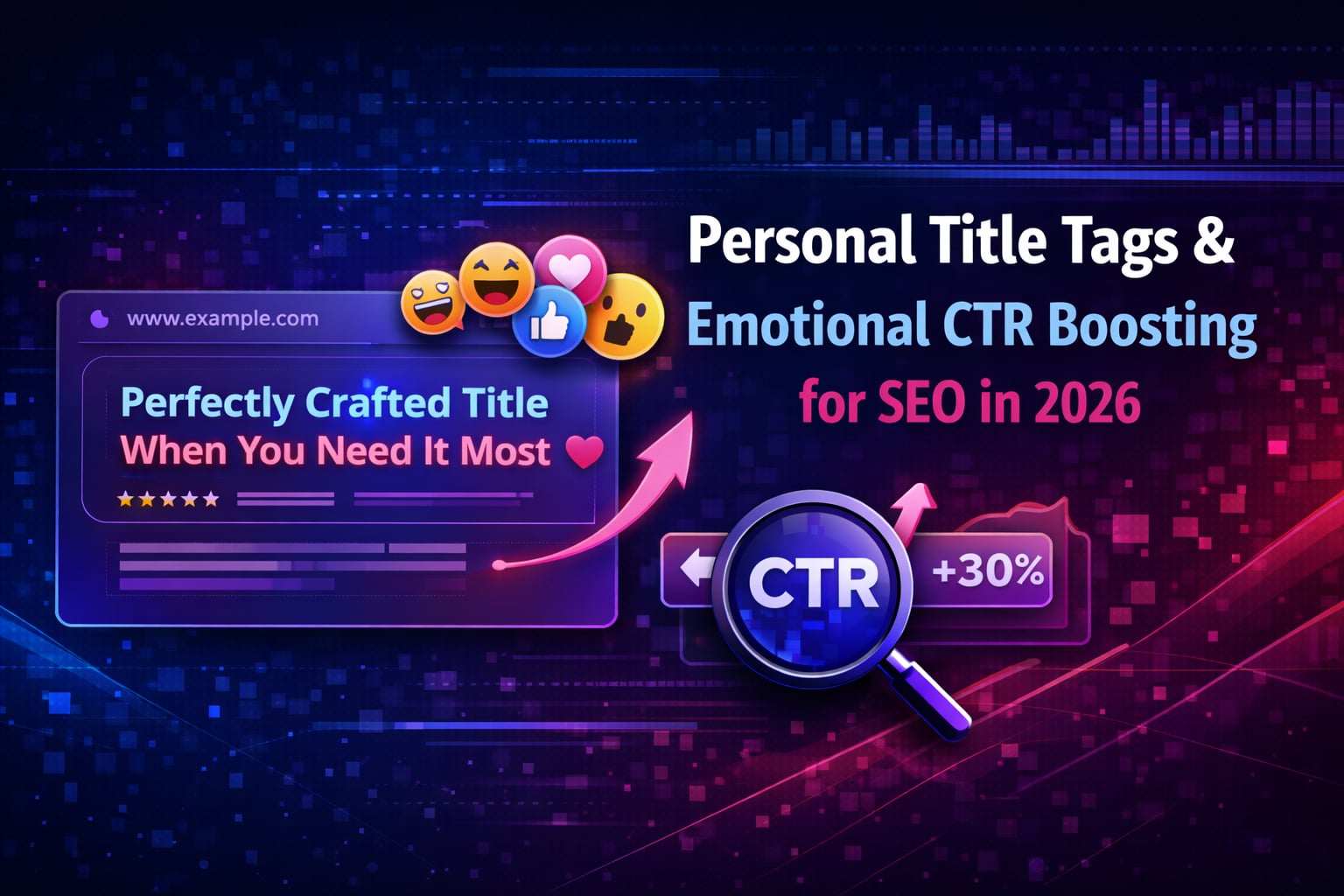
That’s why click-through rate (CTR) has re-emerged as one of the most under-optimized—and most powerful—levers in modern SEO.
And at the center of CTR optimization?
Title tags.
The Rise of Personal Title Tags
A noticeable shift is happening across high-performing SERPs:
first-person, experience-based title tags are outperforming generic ones.
Instead of:
Best SEO Tools for Small Businesses
We now see:
I Tested 15 SEO Tools — Here Are the Only 3 Worth Using
This isn’t clickbait.
It’s psychology.
Why First-Person Titles Work Better in 2026
Search engines like Google have become exceptionally good at ranking relevant results.
So relevance is no longer the differentiator.
Emotion is.
First-person titles trigger:
1. Trust Signals
“I” implies:
- Experience
- Accountability
- Opinion, not aggregation
Users trust people more than faceless lists.
2. Curiosity Gaps
Personal phrasing creates unanswered questions:
- What did they learn?
- What surprised them?
- Do I agree?
Curiosity drives clicks—especially in competitive SERPs.
3. Pattern Disruption
Most SERPs still look like this:
- “Best X for Y”
- “Top Z in 2026”
- “Complete Guide to…”
A personal title breaks visual sameness, pulling the eye instantly.
Emotional CTR Boosting: The Psychology Behind the Click
CTR optimization is applied behavioral psychology.
Users subconsciously ask:
“Which result feels most useful, credible, and relevant to me?”
Effective title tags appeal to:
🔹 Self-Interest
- “What worked for me…”
- “What I wish I knew…”
- “Why I stopped using…”
These imply earned insight, not theory.
🔹 Risk Reduction
- “Mistakes to avoid”
- “What most guides get wrong”
- “The truth about…”
Fear of making the wrong choice is a strong motivator.
🔹 Authority Without Arrogance
- “After analyzing 300 campaigns…”
- “From 5 years of testing…”
- “Lessons learned scaling…”
Specificity builds credibility fast.
Title Tags in an AI-Influenced SERP
AI summaries are changing how results are consumed—but title tags still matter.
Why?
- They influence which links users expand below AI Overviews
- They shape brand perception even without clicks
- They reinforce topical authority signals
Even when users don’t click immediately, emotionally compelling titles:
- Increase brand recall
- Improve assisted conversions
- Influence later branded searches
CTR is no longer just a traffic metric—it’s a visibility signal.
What Actually Works for Title Tags in 2026
1. Blend Keywords With Human Language
This isn’t either/or.
❌
Best CRM Software for Small Businesses
✅
I Tested 12 CRMs for Small Businesses — Here’s the One That Scaled Best
The keyword is still there—but it’s wrapped in intent and emotion.
2. Use Experience Markers (When Honest)
Experience-based modifiers perform exceptionally well:
- “After testing…”
- “From real campaigns…”
- “What actually worked…”
Important: Only use these if the content genuinely delivers.
Mismatch kills trust—and long-term performance.
3. Match Emotional Tone to Intent
Not every query needs excitement.
- Informational → clarity and confidence
- Commercial → risk reduction and proof
- Comparison → decisiveness and authority
Emotion should support intent—not overpower it.
4. Accept That Google May Rewrite (But Still Optimize)
Yes, Google rewrites title tags.
But:
- Strong emotional titles are rewritten less often
- Clear intent alignment reduces rewriting risk
- Even rewritten titles often borrow phrasing from your original
Optimizing titles still influences outcomes—even indirectly.
Common Mistakes With Emotional Title Tags
❌ Over-Clickbaiting
If the content doesn’t deliver, users bounce—and trust erodes.
CTR gains without engagement don’t compound.
❌ Forcing First-Person Everywhere
First-person works best for:
- Blogs
- Case studies
- Comparisons
- Opinion-led content
Not for:
- Product pages
- Legal pages
- Pure documentation
Context matters.
❌ Ignoring Branding
In competitive SERPs, brand recognition boosts CTR.
Well-known brands can use:
- Confidence
- Brevity
- Authority cues
Smaller brands should lean into experience and specificity.
Measuring CTR Success in 2026
Don’t obsess over one metric.
Track:
- Query-level CTR in Search Console
- Performance changes after title updates
- Branded search growth
- Assisted conversion paths
CTR optimization is a compounding strategy, not a one-time tweak.
The Bigger Picture: SEO Is Getting More Human
As AI handles relevance and retrieval, human psychology decides the click.
The brands winning in 2026 aren’t:
- Stuffing keywords
- Writing sterile titles
- Chasing algorithms
They’re:
- Writing like people
- Leveraging emotion responsibly
- Earning attention, not demanding it
Your title tag is often the only chance you get to make someone choose you.
Make it feel human.
