
Personalization Has Moved Beyond Demographics
For years, personalization meant:
- Age
- Gender
- Location
- Basic interests
In 2026, that model is obsolete.
Modern advertising platforms no longer ask who your audience is.
They ask what each user is most likely to do next.
This shift—from static segmentation to predictive, adaptive personalization—is being driven by advances in generative and predictive AI across ad platforms operated by Google, Meta, and AI systems developed by OpenAI.
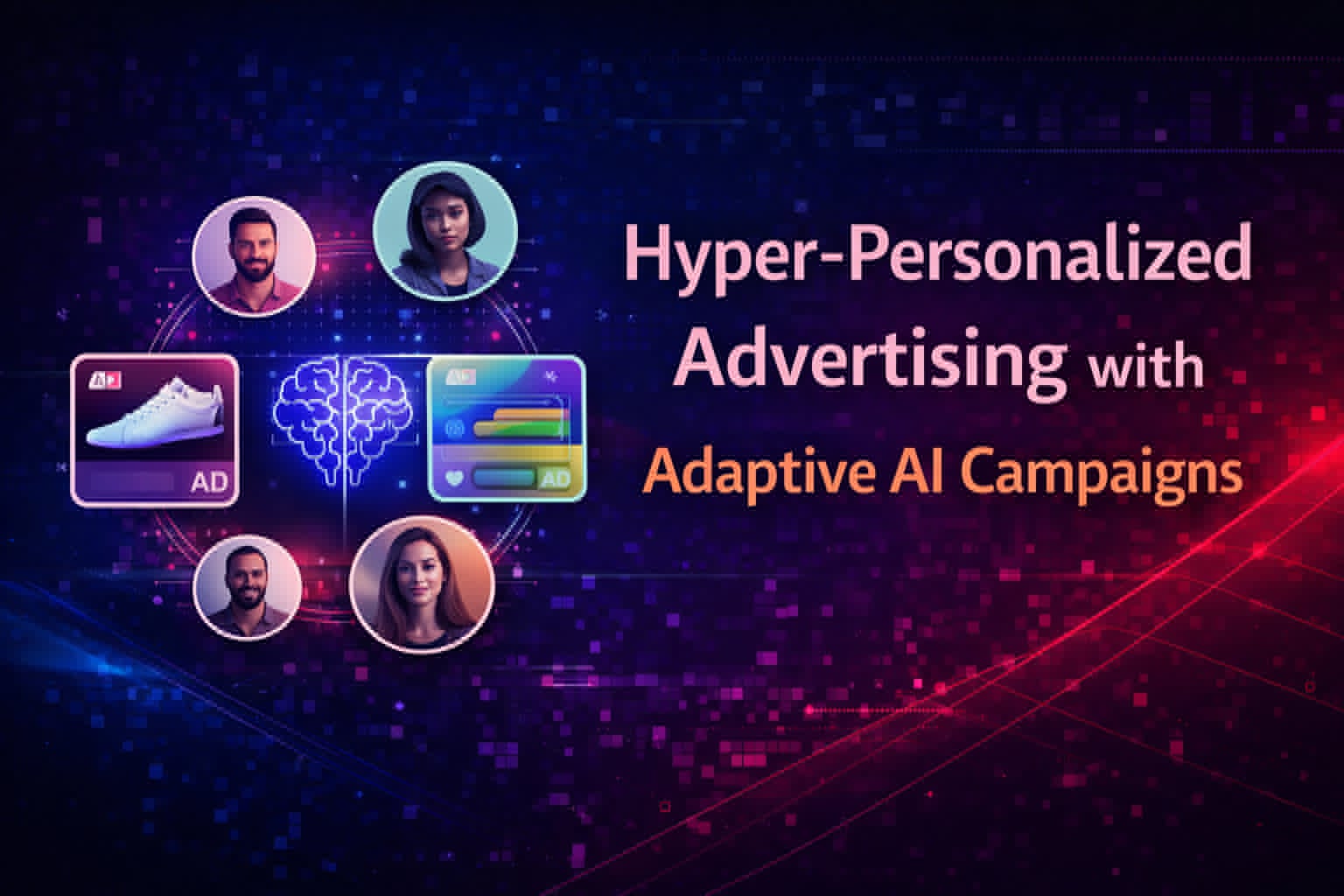
Hyper-personalized advertising isn’t about showing different ads to different people anymore.
It’s about continuously reshaping the campaign itself based on real-time behavioral signals.
What Is Hyper-Personalized Advertising in the AI Era?
Hyper-personalized advertising uses AI to dynamically tailor:
- Messaging
- Creative formats
- Offers
- Timing
- Channels
…based on predicted user intent, not predefined audience buckets.
Instead of fixed segments, AI models create fluid micro-audiences that change as users interact, hesitate, convert, or disengage.
Personalization becomes adaptive—not planned once, but recalculated constantly.
Why Adaptive AI Campaigns Outperform Static Targeting
Traditional segmentation fails because it assumes:
- People behave consistently
- Intent is stable
- Audiences are predictable
AI-driven personalization assumes the opposite.
Adaptive AI Campaigns Win Because They:
- Respond to behavior in real time
- Optimize toward probability, not assumptions
- Adjust creative before performance drops
- Reduce wasted impressions on low-intent users
In short, AI optimizes for likelihood, not labels.
The Core Framework Behind Adaptive AI Campaigns
High-performing hyper-personalized ad strategies follow a clear system—whether brands realize it or not.
1. Predictive Audience Modeling
AI platforms build models based on:
- Engagement patterns
- Conversion signals
- Scroll behavior
- Time-to-action
- Cross-device interactions
Instead of targeting “people interested in fitness,” AI predicts:
“Users with a 72% probability of purchasing in the next 7 days.”
Segmentation becomes probability-based, not interest-based.
2. Signal-Driven Micro-Segmentation
Audiences constantly shift based on signals like:
- Video watch depth
- Click hesitation
- Repeat exposure
- Cart abandonment
- Content interaction
AI breaks audiences into micro-groups such as:
- High intent, low trust
- Interested but price-sensitive
- Educated but undecided
- Ready-to-buy repeat visitors
Each group receives different messaging automatically.
3. Dynamic Creative Personalization
Creative is no longer static.
Adaptive AI campaigns dynamically adjust:
- Hooks
- Value propositions
- Proof points
- CTAs
- Formats (video vs static vs carousel)
The same campaign can show:
- Social proof to skeptical users
- Urgency to high-intent users
- Education to early-stage users
All without manual segmentation.
4. Continuous Learning Loops
Every interaction feeds the system.
AI models learn from:
- Which messages convert faster
- Which users need more touchpoints
- Which creatives fatigue quickly
- Which emotional angles resonate per cohort
This creates a self-optimizing personalization loop:
Behavior → Prediction → Personalization → Performance → Better Prediction
Where Hyper-Personalization Delivers the Biggest Gains
Adaptive AI personalization performs best in:
✅ Mid-to-Lower Funnel Campaigns
Where intent signals are strongest and conversion probability matters most.
✅ Retargeting & Re-Engagement
AI can identify why users didn’t convert—and adjust messaging accordingly.
✅ High-Consideration Purchases
Where different users need different reassurance:
- Proof
- Pricing clarity
- Risk reduction
- Social validation
The Role of Humans in AI-Personalized Advertising
Despite the automation, humans are more important—not less.
Humans must define:
- Brand boundaries
- Ethical guardrails
- Messaging themes
- Offer strategy
- Success metrics
AI decides who sees what.
Humans decide what should ever be shown.
The best-performing teams treat AI as:
A decision engine—not a creative director.
Risks and Misconceptions Around Hyper-Personalization
❌ “AI Will Figure It Out on Its Own”
Without strategic constraints, AI optimizes toward short-term clicks—not long-term brand equity.
❌ Over-Personalization
Too much personalization can feel invasive or inconsistent.
Effective personalization feels:
- Relevant
- Subtle
- Helpful
Not creepy.
❌ Ignoring Creative Quality
AI amplifies whatever it’s given.
Weak creative scaled by AI fails faster—at higher cost.
Measuring Success in Adaptive AI Campaigns
Forget vanity metrics.
Focus on:
- Conversion probability lift
- Time-to-conversion reduction
- Cost per learning
- Creative fatigue resistance
- Incremental lift vs static targeting
Hyper-personalization is about efficiency of persuasion, not just reach.
The Future of Advertising Is Adaptive, Not Predictable
The era of “build once, run for months” campaigns is ending.
AI-driven advertising is:
- Responsive
- Predictive
- Iterative
- Personalized by default
The brands that win won’t ask:
“Who is our audience?”
They’ll ask:
“What does this user need right now to move forward?”Hyper-personalized advertising isn’t about control—it’s about intelligent responsiveness at scale.
