
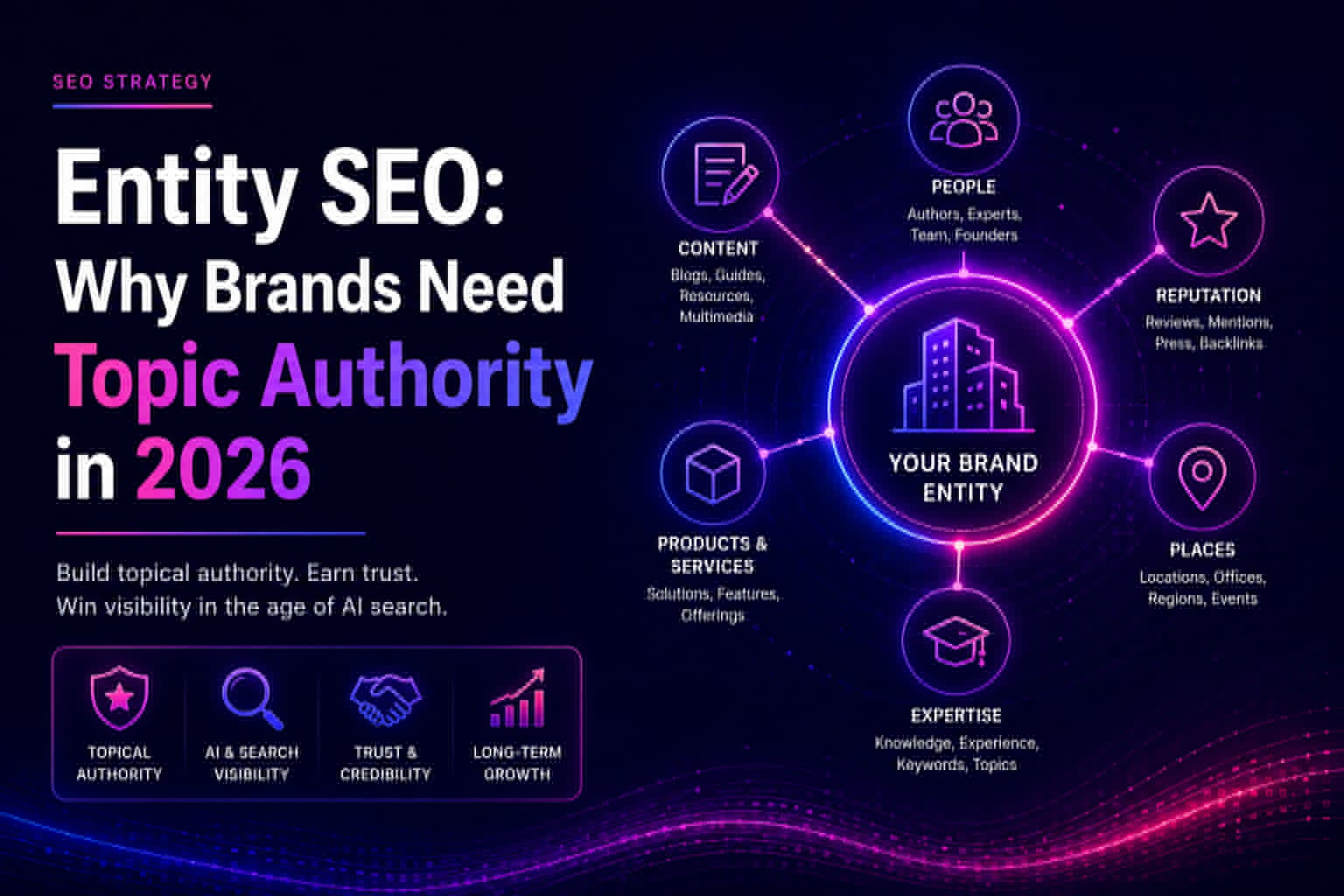
Search engine optimization has evolved far beyond keywords and backlinks.
In 2026, search engines and AI-powered platforms are becoming increasingly focused on understanding concepts, relationships, and expertise rather than simply matching words on a page.
This shift has made entity SEO and topical authority SEO essential components of modern digital marketing strategies.
Brands that establish themselves as trusted authorities around specific topics are more likely to rank higher, earn citations from AI search engines, and build long-term organic visibility.
If your SEO strategy still revolves around targeting isolated keywords, you’re already behind.
Here’s why entity SEO matters in 2026—and how businesses can use semantic SEO strategies to stay ahead.
What Is Entity SEO?
Entity SEO focuses on optimizing content around entities rather than just keywords.
An entity is a person, place, company, product, concept, or topic that search engines can clearly identify and understand.
Examples include:
- OpenAI
- Search Engine Optimization
- ChatGPT
- Ecommerce Marketing
- Local SEO
Instead of relying solely on keyword matching, search engines now analyze relationships between entities and topics.
For example, if your website consistently covers:
- Technical SEO
- On-page SEO
- Link building
- Content optimization
- AI search optimization
Google and AI systems begin recognizing your brand as an authority in SEO as a whole—not just individual keywords.
Why Entity SEO Matters in 2026
The rise of AI-powered search has accelerated the importance of entities.
Platforms like:
- Google AI Overviews
- ChatGPT
- Perplexity
- Gemini
- Claude
don’t simply retrieve pages.
They synthesize information and rely heavily on entity understanding.
This means search visibility increasingly depends on whether AI systems recognize your brand as an authoritative source.
Entity SEO helps search engines understand:
- Who you are
- What topics you specialize in
- How your expertise connects to broader subjects
- Whether your content deserves citations
From Keywords to Knowledge Graphs
Traditional SEO focused on:
- Exact-match keywords
- Search volume
- Ranking positions
Modern search focuses on:
- Context
- Relationships
- User intent
- Knowledge graphs
- Semantic understanding
Google’s Knowledge Graph allows the search engine to understand that related topics belong together.
For example:
Technical SEO is related to:
- Core Web Vitals
- Schema markup
- Crawl budget
- Site architecture
These relationships help Google evaluate expertise across an entire topic rather than individual pages.
What Is Topical Authority SEO?
Topical authority SEO refers to becoming a trusted source within a specific subject area.
Instead of publishing random articles, authoritative brands create comprehensive ecosystems of related content.
For example, a digital marketing agency might build clusters around:
SEO
- Technical SEO
- Local SEO
- Enterprise SEO
- Ecommerce SEO
- AI SEO
Paid Advertising
- Google Ads
- Meta Ads
- LinkedIn Ads
- PPC Optimization
- Conversion Tracking
Content Marketing
- Content Strategy
- Blogging
- Topic Clusters
- Semantic SEO
- AI Content Optimization
As these clusters expand, search engines gain confidence that the website possesses genuine expertise.
Why Topical Authority Beats Keyword Stuffing
Years ago, many websites ranked by producing hundreds of keyword-focused pages.
Today, that approach rarely works.
Search engines prioritize:
- Expertise
- Relevance
- Content depth
- Topic coverage
- Semantic relationships
Publishing ten comprehensive articles around one topic often outperforms publishing one hundred unrelated articles.
Quality and context matter more than sheer volume.
How Semantic SEO Strategy Supports Entity SEO
Semantic SEO focuses on meaning rather than exact keywords.
Instead of optimizing only for one phrase, semantic SEO incorporates related concepts and entities.
For example, an article about local SEO might naturally include:
- Google Business Profile
- Citations
- NAP consistency
- Local rankings
- Reviews
- Maps optimization
This richer context helps search engines understand the page more accurately.
Semantic SEO strategy improves:
- Content relevance
- AI discoverability
- Featured snippets
- AI citations
- Search visibility
How AI Search Engines Use Entities
AI search platforms are changing how users find information.
Instead of listing pages, AI systems generate answers.
To do this effectively, they rely heavily on entities and relationships.
AI engines evaluate:
- Authority
- Context
- Expertise
- Source reliability
- Topic depth
Brands that demonstrate strong topical authority are more likely to:
- Be cited in AI answers
- Receive referral traffic
- Increase brand awareness
- Build trust with users
Entity SEO is quickly becoming the foundation of Generative Engine Optimization (GEO).
Building Topical Authority in 2026
Create Topic Clusters
Rather than publishing isolated articles, organize content into clusters.
Example:
Pillar Page:
Complete Guide to Technical SEO
Supporting Pages:
- Schema Markup Guide
- Core Web Vitals Explained
- XML Sitemap Best Practices
- Crawl Budget Optimization
- Internal Linking Strategies
This structure helps search engines understand relationships between topics.
Strengthen Internal Linking
Internal links connect entities and reinforce topic relevance.
Good internal linking helps:
- Distribute authority
- Improve crawlability
- Build semantic relationships
- Enhance user experience
Every article should support a broader content ecosystem.
Use Structured Data
Schema markup helps search engines identify entities clearly.
Useful schema types include:
- Organization
- Article
- FAQ
- Product
- Local Business
- Author
Structured data improves machine readability and supports AI understanding.
Cover Topics Deeply
Comprehensive content wins.
Instead of producing surface-level articles, answer:
- What?
- Why?
- How?
- When?
- Common mistakes
- Best practices
Search engines reward complete coverage.
Demonstrate Expertise
Topical authority isn’t just about content quantity.
Search engines also consider:
- Author expertise
- Brand reputation
- Backlinks
- User engagement
- Consistency
Building authority takes time, but the results are sustainable.
Common Entity SEO Mistakes
Publishing Random Topics
Unfocused content weakens topical authority.
Stay within your core expertise.
Targeting One Keyword Per Page
Modern SEO requires broader semantic coverage.
Optimize for concepts, not just keywords.
Ignoring Internal Links
Disconnected pages make it harder for search engines to understand relationships.
Creating Thin Content
Shallow articles provide little value and rarely establish authority.
Depth matters.
Chasing Every Trend
Not every trending keyword belongs in your content strategy.
Relevance is more important than volume.
Entity SEO and the Future of Search
Search is becoming increasingly intelligent.
Google and AI systems are moving away from:
- Keyword matching
And toward:
- Understanding
- Context
- Relationships
- Authority
As AI-generated search experiences expand, brands with strong entity signals will enjoy significant advantages.
The future belongs to businesses that become trusted sources—not just websites with optimized keywords.
Final Thoughts
Entity SEO is redefining how brands compete online.
Success in 2026 depends less on individual keywords and more on building expertise around entire subjects.
By developing topical authority and implementing a semantic SEO strategy, businesses can improve:
- Organic rankings
- AI visibility
- Brand authority
- Search relevance
- Long-term growth
Search engines are no longer asking, “Does this page contain the keyword?”
They’re asking:
“Is this brand truly an authority on the topic?”
The brands that answer “yes” will dominate the future of search.
