
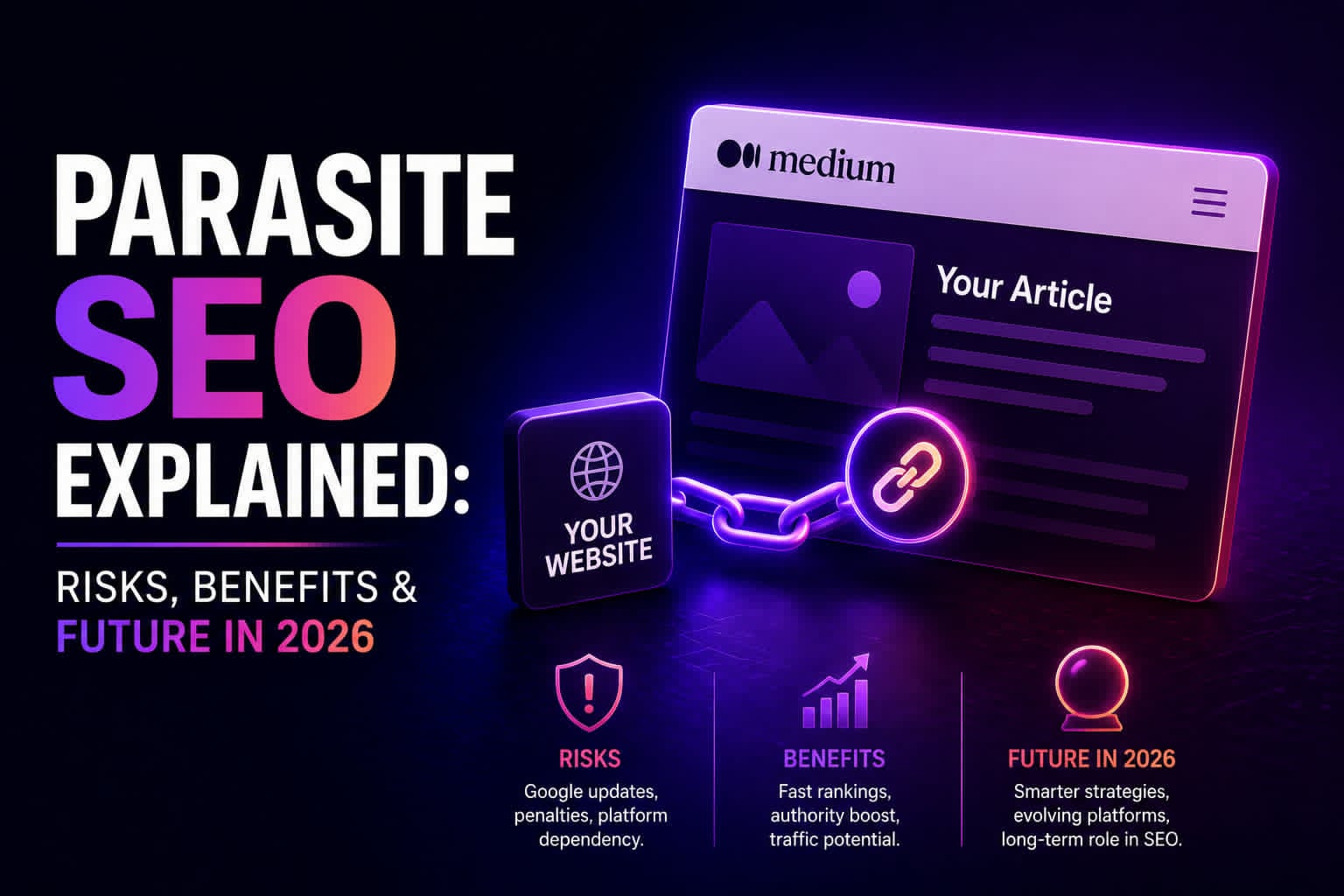
Over the past few years, parasite SEO has become one of the most talked-about—and controversial—SEO strategies.
Some marketers use it to rank competitive keywords within days instead of months. Others view it as a short-term tactic that carries significant risks.
With Google’s continued focus on helpful content, E-E-A-T, spam prevention, and AI-powered search, many businesses are asking:
Does parasite SEO still work in 2026?
The short answer is: Yes, but with important limitations and growing risks.
This guide explains what parasite SEO is, how it works, parasite SEO examples, its advantages and disadvantages, and whether it should be part of your long-term SEO strategy.
What Is Parasite SEO?
Parasite SEO is the practice of publishing content on an established, high-authority website to rank for competitive search terms instead of trying to rank a page on your own domain.
Rather than relying on your website’s authority, you “borrow” the authority of another platform that already has strong trust and visibility in search engines.
Common platforms include:
- Medium
- LinkedIn Articles
- Quora
- GitHub
- Industry publications
- News websites
- High-authority blogs
Because these domains already have significant authority, their pages can often rank much faster than content on a newer website.
How Does Parasite SEO Work?
A typical parasite SEO strategy follows these steps:
- Identify a competitive keyword.
- Choose a high-authority publishing platform.
- Publish optimized, valuable content on that platform.
- Include relevant internal or external links where permitted.
- Promote the content to increase engagement and visibility.
Instead of building domain authority from scratch, you’re leveraging an existing platform’s reputation.
Parasite SEO Examples
Here are several legitimate examples of parasite SEO in action.
Medium Articles
Many businesses publish educational articles on Medium targeting niche keywords.
Because Medium has strong domain authority, articles can rank relatively quickly for long-tail searches.
LinkedIn Articles
Professionals often publish industry insights on LinkedIn that appear in Google search results.
These articles help establish thought leadership while reaching audiences beyond LinkedIn itself.
Reddit Discussions
Helpful Reddit threads frequently rank for comparison, troubleshooting, and recommendation queries.
Brands that participate authentically may gain visibility through community-driven discussions, although overt self-promotion is often discouraged.
Quora Answers
Well-written answers addressing common questions can rank for informational searches.
Success depends on providing genuine value rather than promotional content.
Guest Posts on Industry Websites
Publishing expert content on respected industry blogs is another form of leveraging external authority.
Unlike spammy tactics, editorial guest posts focus on educating readers while building credibility.
Benefits of Parasite SEO
When executed ethically, parasite SEO offers several advantages.
Faster Rankings
High-authority platforms are crawled and indexed frequently, allowing content to appear in search results more quickly.
Lower Barrier to Entry
New websites often struggle to compete for competitive keywords.
Publishing on established domains provides an opportunity to gain visibility while your own site’s authority grows.
Increased Brand Exposure
Ranking on multiple platforms expands your digital footprint and introduces your brand to new audiences.
Referral Traffic
Many authoritative platforms can drive qualified referral traffic alongside organic search visibility.
Risks of Parasite SEO
Despite its advantages, parasite SEO comes with significant limitations.
You Don’t Own the Platform
The platform controls:
- Content policies
- Visibility
- Moderation
- Account access
Your content can be edited, removed, or deprioritized at any time.
Limited Control Over SEO
Many platforms restrict:
- Internal linking
- Schema markup
- Technical SEO
- URL structure
- Metadata customization
These limitations reduce your ability to optimize pages fully.
Algorithm Changes
Search engines continue refining how they evaluate third-party content.
Pages that rank today may lose visibility if algorithms begin favoring first-party content or reducing the prominence of low-value, platform-hosted pages.
Spam Signals
Many marketers abuse parasite SEO by publishing thin, keyword-stuffed, or purely promotional content.
Google has increased efforts to identify and reduce the visibility of low-quality content, regardless of where it is hosted.
Does Parasite SEO Still Work in 2026?
Yes—but not in the way it once did.
Several years ago, simply publishing keyword-optimized articles on high-authority domains could produce quick rankings.
Today, search engines evaluate far more than domain authority.
Successful content now needs to demonstrate:
- Original insights
- Helpful information
- User satisfaction
- Topical relevance
- Credibility
- Strong engagement signals
Authority alone is no longer enough.
High-quality content published on authoritative platforms still has the potential to rank, but low-value “parasite” content is increasingly vulnerable to algorithm updates.
Parasite SEO vs Traditional SEO
| Factor | Parasite SEO | Traditional SEO |
| Speed to rank | Fast | Slower |
| Platform ownership | No | Yes |
| Long-term stability | Lower | Higher |
| Technical SEO control | Limited | Full |
| Brand authority | Shared | Builds your own |
| Scalability | Limited | High |
For most businesses, traditional SEO provides more sustainable long-term value.
Should You Use Parasite SEO?
The answer depends on your goals.
Parasite SEO may be appropriate if you want to:
- Test keyword opportunities
- Build brand awareness
- Reach established communities
- Support digital PR campaigns
- Supplement your content marketing strategy
It should not replace building authority on your own website.
Your domain remains your most valuable long-term SEO asset because you control the content, technical optimization, user experience, and overall strategy.
Best Practices for Parasite SEO
If you choose to use a parasite SEO strategy, follow these guidelines:
- Publish genuinely helpful, original content.
- Follow each platform’s editorial guidelines.
- Avoid keyword stuffing or excessive self-promotion.
- Use parasite SEO to complement—not replace—your website.
- Link naturally to relevant resources where permitted.
- Focus on building brand credibility rather than exploiting authority.
This approach aligns better with modern search quality standards and reduces the risk of penalties or poor user engagement.
The Future of Parasite SEO
As AI-driven search continues to evolve, search engines are becoming better at evaluating content quality regardless of where it is published.
Rather than rewarding pages simply because they appear on high-authority domains, algorithms increasingly prioritize:
- Expertise
- Originality
- User value
- Trustworthiness
- Contextual relevance
This means the future of parasite SEO is likely to favor authentic contributions on reputable platforms while making it harder for low-quality, manipulative content to succeed.
Final Thoughts
Parasite SEO remains a viable tactic in 2026, but it is no longer a shortcut to sustainable search success.
Publishing high-quality content on trusted platforms can increase visibility, drive referral traffic, and strengthen your brand. However, relying solely on third-party websites leaves you vulnerable to policy changes, limited optimization options, and evolving search algorithms.
For long-term growth, the most effective strategy is to use parasite SEO selectively—supporting a broader SEO plan centered on building topical authority, earning quality backlinks, and growing the authority of your own website.
Frequently Asked Questions
What is parasite SEO?
Parasite SEO is the practice of publishing content on high-authority third-party websites to rank for search keywords using the platform’s existing authority rather than your own domain.
Is parasite SEO against Google’s guidelines?
Publishing valuable content on third-party platforms is not inherently against Google’s guidelines. However, using those platforms to manipulate search rankings with low-quality, spammy, or deceptive content can violate search spam policies.
Does parasite SEO still work?
Yes, but success now depends far more on content quality, relevance, and user value than simply publishing on a high-authority website.
Is parasite SEO better than traditional SEO?
No. Parasite SEO can be useful for short-term visibility or brand exposure, but traditional SEO builds long-term authority, gives you full control over your content, and provides more sustainable organic growth.
