
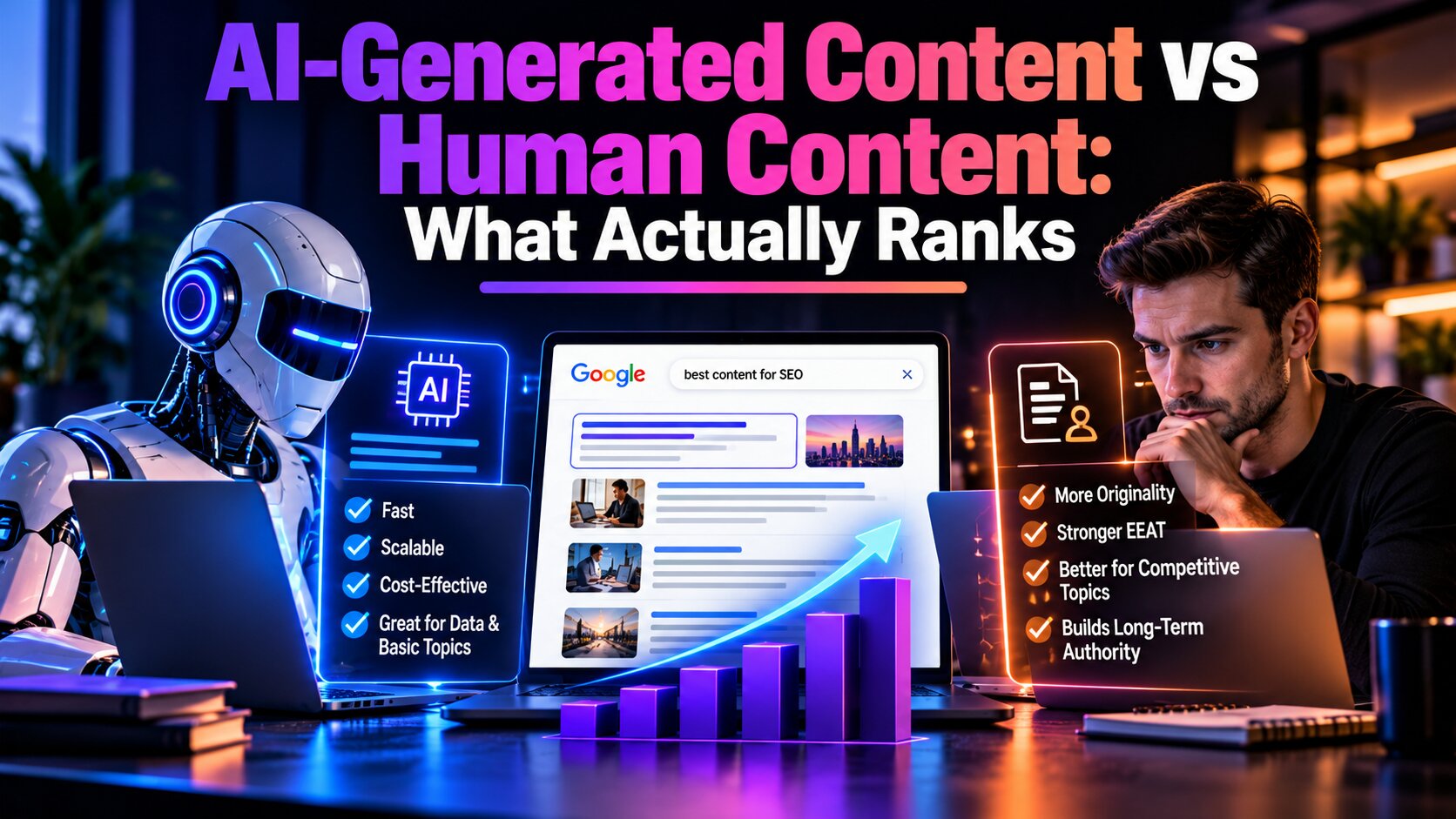
AI has made content creation easier than ever. With tools like ChatGPT, businesses can now produce blog posts, website copy, and even complete articles in minutes.
But there’s one question that keeps coming up: Does AI-generated content actually rank as well as human-written content on Google?
Some businesses are producing hundreds of AI-written articles to increase their online visibility. Others still rely on human writers, believing that original experience and expertise will always perform better.
So, who’s right?
The short answer is that both AI-generated and human-written content can rank on Google. What matters most is how helpful, accurate, and relevant the content is to the people searching for it.
However, recent research suggests there’s more to the story.
What’s the Difference Between AI and Human-Written Content?
AI-generated content is produced using tools such as ChatGPT, Gemini, or Claude. These tools can create articles, summaries, and other written materials based on instructions provided by the user.
The biggest advantage is speed. An AI tool can generate a complete article in minutes, making it useful for businesses managing large amounts of website content.
However, AI doesn’t automatically understand your business, customers, or real-world experiences. Without proper guidance and review, it can produce repetitive explanations, outdated information, or content that sounds good but doesn’t offer anything particularly useful.
Human-written content, on the other hand, comes from a writer’s knowledge, research, and experience.
For example, an SEO specialist who has worked on website migrations can explain the actual challenges involved, from identifying broken redirects to troubleshooting indexing problems.
That practical knowledge can make an article more meaningful to readers.
Here’s a simple comparison:
| Factor | AI-Generated Content | Human-Written Content |
| Writing speed | Fast | Generally slower |
| Original experience | Requires human input | Can draw from personal experience |
| Accuracy | Needs fact-checking | Also needs fact-checking |
| Content quality | Depends on prompts and editing | Depends on writer expertise |
| SEO potential | Can rank | Can rank |
Neither approach automatically guarantees better rankings. The difference comes down to the value of the finished content.
Does Google Prefer Human-Written Content Over AI Content?
One common misconception is that Google automatically penalises articles written using AI. That’s not the case.
According to Google Search Central’s guidance on generative AI content, AI can help with research and structuring original content.
Google’s concern is when websites use AI or other methods to produce large amounts of content primarily to manipulate search rankings without providing meaningful value.
Imagine two websites publishing articles about the same subject.
The first website publishes 50 AI-generated articles filled with similar explanations and repetitive information.
The second publishes five well-researched articles that answer specific questions, include practical examples, and provide genuinely useful advice.
The second website may offer a better experience for readers, even though it publishes significantly less content.
This doesn’t mean Google automatically rewards websites for publishing fewer articles. It means that producing content at scale is not a substitute for creating something useful.
How Does E-E-A-T Affect Content Rankings?
Google also discusses E-E-A-T, which stands for Experience, Expertise, Authoritativeness, and Trustworthiness.
These concepts help explain what makes content reliable and valuable.
For instance, an article explaining technical SEO becomes more useful when the writer understands the subject and can support recommendations with accurate information.
An article about website migrations might be more convincing if it includes real examples of redirects, indexing problems, or organic traffic changes.
AI can help organise these explanations, but genuine first-hand experience needs to come from someone who has actually done the work.
It’s worth remembering that E-E-A-T isn’t a single Google ranking factor. Rather, Google’s systems use a combination of signals to identify content that demonstrates these qualities.
AI vs Human Content: What Does the Ranking Data Show?
So, what does the research say?
A Semrush study published in April 2026 analysed 42,000 blog posts across 20,000 keywords to compare the rankings of content classified as AI-generated and human-written.
The results were interesting:
- 80% of number-one ranking results were classified as human-written content.
- 9% were classified as purely AI-generated content.
- Human-classified content appeared more frequently across Google’s top-ranking results.
At first glance, that sounds like a clear win for human writers.
However, there’s an important limitation.
The study relied on AI detection technology to classify the content. These tools aren’t always accurate and can sometimes incorrectly identify whether a person or AI created an article.
The findings also don’t prove that Google directly favours human-written content. Factors such as backlinks, website authority, content quality, and search intent can also influence rankings.
Still, the study highlights something worth considering: human-classified content remains strongly represented in the highest-ranking search results.
Why Can Human-Written Content Perform Better?
Think about the last time you searched for advice on improving your website’s SEO. You probably found several articles recommending keyword research, quality content, internal linking, and technical optimisation.
Those recommendations are useful, but you’ve likely read them many times before.
Now imagine finding an article explaining how a company improved its website visibility after fixing a sitemap issue, updating service pages, and improving internal links.
The article includes actual examples, challenges, and lessons learned.
That second article provides something more specific than general advice.
This is where human experience can help content stand out.
It’s not necessarily that human-written words rank better. It’s that writers with relevant expertise can contribute original information that generic articles often lack.
Can AI-Generated Content Still Rank on Google’s First Page?
Absolutely. AI-generated and AI-assisted content can reach Google’s first page when they meet the needs of users and compete effectively against existing results.
For example, AI can help an SEO specialist organise research, create an outline, and improve how technical information is explained.
The specialist can then review the article, verify the facts, and add relevant examples or insights. This approach combines AI’s efficiency with human expertise. The important thing is not to confuse a finished-looking draft with a genuinely useful article. A well-structured AI-assisted article can still be weak if it simply repeats information already available elsewhere.
Final Verdict: Which Type of Content Actually Ranks Better?
If you’re choosing between AI-generated and human-written content, don’t focus only on who or what produces the words.
Google aims to reward helpful, reliable content created for people, regardless of whether AI was involved in the writing process.
Human-written content has an advantage when the writer contributes real experience, original research, and practical knowledge.
AI-generated content offers speed and efficiency, but it works best when someone takes responsibility for its accuracy, relevance, and quality.
For many businesses, a combination of AI assistance and human expertise is a practical approach.
Instead of asking whether AI or humans write better content, ask whether your article provides something readers can actually use.
That’s a much better starting point for creating content that deserves to rank.
Frequently Asked Questions
Can AI-generated content rank on Google?
Yes. AI-generated content can rank on Google if it is helpful, accurate, relevant, and complies with Google’s search policies. Google does not automatically exclude articles because AI was used to write them.
Does Google penalise AI-written content?
Google doesn’t automatically penalise content for being AI-generated. However, generating large amounts of low-value content primarily to manipulate search rankings may violate Google’s spam policies.
Is human-written content better for SEO?
Human-written content can offer advantages when it includes original research, first-hand experience, and expert knowledge. However, both human-written and AI-assisted articles can perform well when they satisfy search intent and provide useful information.
