
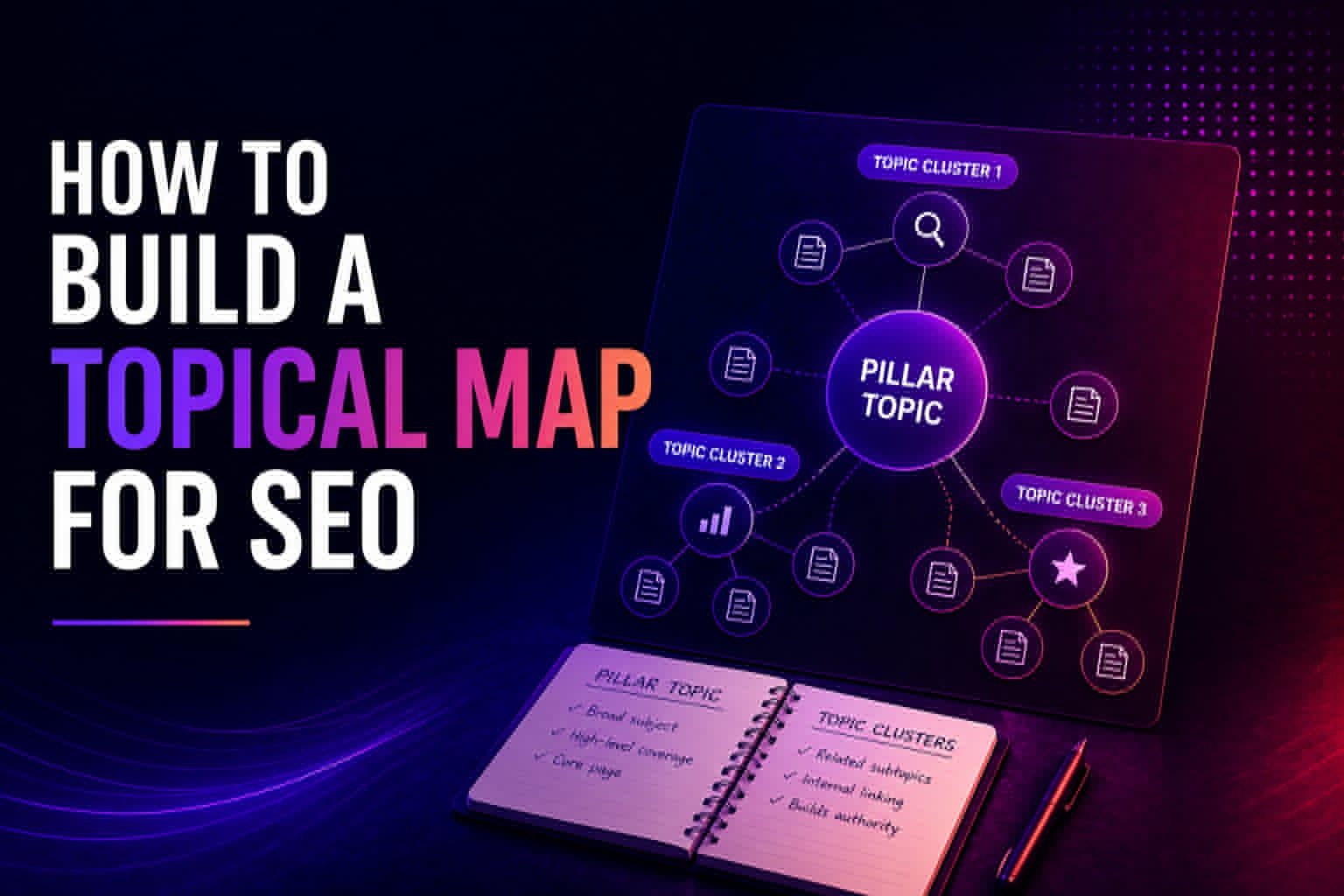
Creating quality content is no longer enough to achieve sustainable search rankings. Search engines increasingly evaluate how well your website covers an entire subject—not just how well an individual page targets a keyword.
This is where a topical map SEO strategy becomes essential.
A topical map helps you organize content around a central theme, making it easier for search engines to understand your expertise while guiding users through related topics. Combined with well-structured SEO topical clusters, it forms the foundation of strong topical authority.
In this guide, you’ll learn what a topical map is, why it matters, and how to build a topical authority map that supports long-term organic growth.
What Is a Topical Map?
A topical map is a strategic framework that organizes all of your content around a core subject and its related subtopics.
Instead of targeting isolated keywords, a topical map ensures your website comprehensively covers every important aspect of a topic.
For example, if your primary topic is SEO, your topical map might include:
- Technical SEO
- On-page SEO
- Off-page SEO
- Local SEO
- E-commerce SEO
- SEO content strategy
- Keyword research
- Link building
- Core Web Vitals
- AI search optimization
Each topic is supported by multiple related pages, creating a logical content structure.
Why Topical Maps Matter for SEO
Modern search engines rely on semantic understanding rather than exact keyword matching.
A website that demonstrates expertise across an entire topic is more likely to be recognized as an authoritative resource.
A strong topical map helps:
- Build topical authority
- Improve keyword coverage
- Strengthen internal linking
- Increase crawl efficiency
- Enhance user experience
- Support rankings for related search terms
- Improve visibility in AI-powered search results
Rather than competing page by page, you’re building authority across an entire subject area.
Topical Map vs Keyword List
Many businesses still approach SEO by creating a list of target keywords.
While keyword research remains important, it doesn’t provide the structure needed for long-term authority.
| Keyword List | Topical Map |
| Individual keywords | Connected topics |
| Focuses on search volume | Focuses on subject coverage |
| Limited internal linking | Strong internal linking |
| Short-term optimization | Long-term authority building |
| Page-centric | Topic-centric |
A topical map organizes keywords into meaningful content relationships instead of treating each keyword as a separate project.
Step 1: Choose Your Core Topic
Begin with one broad topic that aligns with your business, expertise, or services.
Examples include:
- Digital marketing
- Cybersecurity
- Property tax reduction
- AI training
- Lawn care
- Project management
This becomes the foundation of your topical map.
Avoid trying to cover unrelated industries on the same website unless they naturally connect.
Step 2: Identify Core Topic Categories
Break your main topic into major subject areas.
For an SEO website, these might include:
- Technical SEO
- Content SEO
- Local SEO
- Enterprise SEO
- Link building
- Analytics
- AI SEO
- International SEO
These categories will typically become pillar pages or content hubs.
Step 3: Build SEO Topical Clusters
Each pillar topic should support multiple related articles that answer specific user questions.
For example:
Pillar: Technical SEO
Supporting cluster pages:
- XML Sitemap Guide
- Robots.txt Best Practices
- Canonical Tags Explained
- Core Web Vitals Guide
- Structured Data Basics
- Crawl Budget Optimization
- Site Speed Optimization
- Indexing Issues
Each supporting article links back to the pillar page while also linking to related cluster content.
This creates interconnected SEO topical clusters that strengthen topical relevance.
Step 4: Research Supporting Keywords
Instead of targeting only high-volume keywords, identify:
- Related searches
- Long-tail keywords
- Frequently asked questions
- Semantic variations
- User intent
- Emerging industry topics
These keyword groups become individual articles within your topical clusters.
The goal is comprehensive coverage—not keyword stuffing.
Step 5: Map Internal Links
Internal linking is one of the most important components of a topical authority map.
A strong structure typically includes:
- Pillar page → Cluster pages
- Cluster pages → Pillar page
- Cluster pages → Related cluster pages
- Category pages → Pillar pages
- Relevant blog posts → Service pages (where appropriate)
This helps search engines understand the relationships between your content and distributes authority across your site.
Step 6: Prioritize Content Creation
You don’t need to publish everything at once.
Start with:
- Pillar page
- Five to ten supporting cluster articles
- Internal linking
- Additional supporting content over time
Building authority is a gradual process.
Publishing consistent, high-quality content is more effective than creating dozens of thin pages.
Step 7: Keep Your Topical Map Updated
Search behavior and industry trends evolve continuously.
Review your topical map regularly to:
- Add emerging topics
- Update outdated content
- Expand existing clusters
- Remove outdated information
- Improve internal links
- Refresh statistics and examples
A living topical map keeps your content relevant and competitive.
Common Mistakes to Avoid
When building a topical map, avoid these common pitfalls:
- Creating duplicate content targeting similar keywords
- Publishing isolated articles with no internal links
- Covering unrelated topics without a clear strategy
- Ignoring user intent
- Focusing only on search volume
- Neglecting content updates after publication
A topical map should reflect how users naturally explore a subject, not just how keywords appear in research tools.
Tools That Can Help
Several tools can simplify topical mapping and content planning:
- Google Search Console
- Google Keyword Planner
- Ahrefs
- Semrush
- Screaming Frog
- AlsoAsked
- AnswerThePublic
- Google Trends
These tools help uncover related questions, content gaps, and opportunities for expanding your topical coverage.
Example Topical Map Structure
Here’s a simplified example for an SEO website:
Pillar: SEO
Cluster 1: Technical SEO
- Core Web Vitals
- XML Sitemaps
- Robots.txt
- Canonical Tags
- Crawl Budget
Cluster 2: Content SEO
- Keyword Research
- Content Optimization
- Content Decay
- Internal Linking
- Topic Clusters
Cluster 3: AI SEO
- AI Search Optimization
- AI Overviews
- Generative Engine Optimization (GEO)
- Prompt Optimization
- AI Content Best Practices
This structure creates a comprehensive network of related content that reinforces your expertise.
Final Thoughts
A well-planned topical map SEO strategy helps your website move beyond ranking for individual keywords to becoming a trusted resource on an entire subject.
By organizing content into logical SEO topical clusters, strengthening internal linking, and maintaining a comprehensive topical authority map, you improve both user experience and search engine understanding of your expertise.
As search continues to evolve toward semantic relevance and AI-driven results, websites with strong topical structures will be better positioned to earn sustainable rankings, attract qualified traffic, and build long-term authority.
Frequently Asked Questions
What is a topical map in SEO?
A topical map is a content strategy that organizes pages around a central subject and related subtopics to improve topical authority and search visibility.
How is a topical map different from topic clusters?
A topical map is the overall content framework, while topic clusters are groups of related pages connected to a specific pillar page within that framework.
How many articles should a topical cluster include?
There is no fixed number. Most effective clusters contain one comprehensive pillar page supported by several in-depth articles covering related subtopics.
Do topical maps improve rankings?
While no strategy guarantees rankings, topical maps help search engines better understand your expertise, improve internal linking, increase semantic relevance, and support stronger long-term organic performance.
