
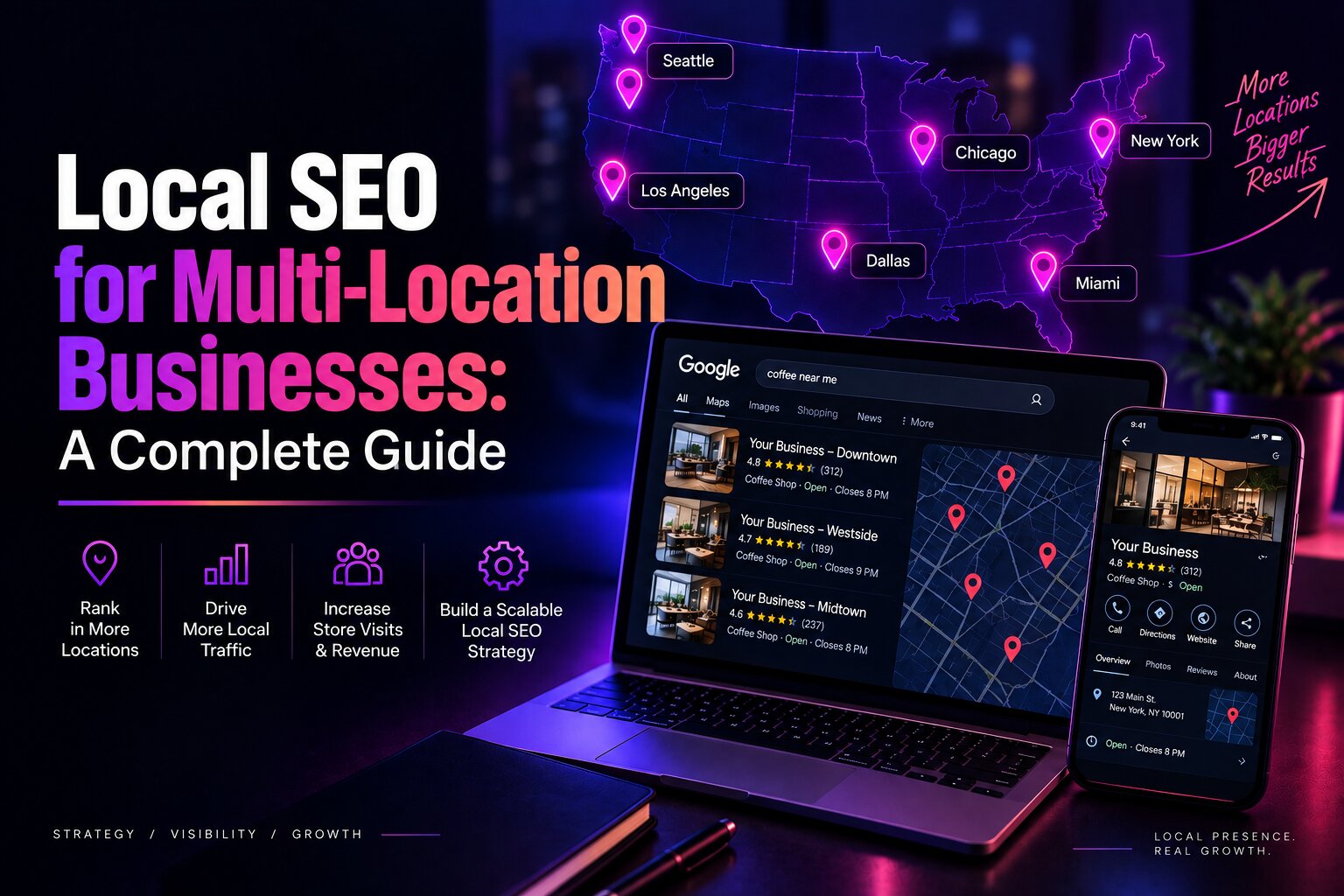
For businesses with multiple branches, franchises, or service locations, appearing in local search results can be challenging. A business may have strong visibility in one city while struggling to rank in another, even when the same products or services are available across all locations. This is where multi-location SEO becomes essential.
Multi-location SEO is the process of optimising a business’s website, Google Business Profiles, local content, citations, reviews, and other online signals so that individual locations can appear prominently in local search results.
Whether you operate a franchise network, regional branches, or multiple offices, an effective strategy needs to combine brand-wide consistency with location-specific relevance. This helps each location compete in its own market while maintaining a unified online presence.
Why Multi-Location SEO Matters
Search engines use location and search intent to determine which businesses are most relevant to users. Someone searching for “plumber near me” or “accountant in Manchester” is generally looking for a nearby business rather than a company located hundreds of miles away.
For a business with multiple locations, this creates an important challenge: each location needs to demonstrate its relevance to its own local market. A strong multi-location SEO strategy can help businesses:
- Increase visibility in Google Search and Google Maps
- Generate more calls and enquiries
- Drive customers to individual branches
- Improve organic visibility for location-specific searches
- Build stronger local brand awareness
- Identify and address performance gaps between locations
A national brand, for example, may rank well for its brand name but still need dedicated optimisation to appear for non-branded searches such as “dentist in Birmingham” or “IT support in Leeds.”
This makes local SEO an important component of a broader SEO strategy.
What Is Multi-Location SEO?
Multi-location SEO is the practice of optimising a business’s online presence for multiple physical locations or service areas. It includes the optimisation of:
- Google Business Profiles
- Location landing pages
- Local keywords
- On-page SEO
- Local citations
- Reviews
- Local backlinks
- Structured data
- Technical SEO
- Location-specific content
Multi-Location SEO vs. Single-Location SEO
A single-location business can generally focus its local SEO efforts on one geographic market. A multi-location business has to manage multiple markets simultaneously.
For example, a company with offices in Florida, New York, and Arizona needs to ensure that each location has accurate business information and a strong local presence.
The goal is not simply to make one website rank nationally. Instead, the strategy should help each legitimate location become relevant to customers searching in that area. Multi-location SEO can apply to:
- Franchise businesses
- Retail chains
- Healthcare groups
- Professional service firms
- Restaurants with multiple branches
- Companies with regional offices
- Businesses operating across multiple service areas
Build a Scalable Google Business Profile Strategy
Google Business Profile (GBP) is one of the most important components of local SEO. Eligible businesses with multiple physical locations should generally have an appropriate Google Business Profile for each eligible location rather than trying to represent every branch through one profile. Each profile should contain accurate and consistent information, including:
- Business name
- Address
- Phone number
- Primary and secondary categories
- Opening hours
- Website URL
- Services
- Photos
- Business description where applicable
However, businesses should avoid creating profiles for locations that do not meet Google’s eligibility requirements. Duplicate or ineligible profiles can create confusion for users and may result in visibility or profile-management problems. The information on each profile should also remain accurate as locations open, close, relocate, or change their operating hours. For more information, see our guide to Google Business Profile optimisation.
Create Optimised Local Landing Pages
A dedicated local landing page gives each location its own place on the website and allows search engines to understand where the business operates.
For example:
- /locations/florida/
- /locations/texas/
- /locations/new-york/
The exact URL structure can vary depending on the website, but it should be logical, scalable, and easy for users and search engines to understand. Each location page should provide genuinely useful information about that particular location. This may include:
- Location-specific services
- Address and contact details
- Opening hours
- Directions
- Parking information
- Nearby landmarks
- Local service information
- Relevant FAQs
- Photos of the location
- Information about the local team or facilities where appropriate
The page title, H1, headings, URL, and meta description can also be optimised around relevant local search intent. For example, instead of using a generic title such as:
Professional Services | Company Name
a location page could use:
Professional Services in Manchester | Company Name
The content should also be unique enough to provide genuine value. Simply copying the same page and replacing “New York” with “Florida” does not create a strong local experience. A useful landing page SEO strategy should focus on what makes each location relevant to customers in that market.
Develop a Franchise SEO Strategy
Franchise businesses have an additional challenge: they need to maintain brand consistency while allowing individual locations to build local relevance. A strong franchise SEO strategy should establish centralised standards for areas such as:
- Google Business Profile management
- Local landing pages
- NAP information
- Reviews
- Local citations
- Internal linking
- Local content
- Metadata
- Structured data
At the same time, franchisees should have opportunities to provide location-specific information.
For example, a central marketing team can establish the structure and technical standards for every location page, while individual franchise locations contribute information about their local team, community involvement, services, events, and customer needs. This creates a scalable framework without making every location appear identical. The objective is to establish consistent foundations with local-level customisation.
Optimise Local On-Page SEO
Each location page should clearly communicate what the business offers and where it operates. One of the simplest ways to do this is to incorporate location and service keywords naturally throughout the page. For example:
- “accountant in Texas”
- “commercial cleaning services in New York”
- “family dentist in Arizona”
However, keyword usage should never come at the expense of readability.
Important on-page elements include:
Page Titles
Include the primary service and location where appropriate.
Headings
Use headings to organise information around the services, location, and questions users are likely to have.
Internal Links
Link relevant location pages to service pages and vice versa. This can help users navigate the website while also helping search engines understand the relationship between services and locations. For example, a location page for Manchester could link to the business’s relevant commercial cleaning services.
Structured Data
Appropriate LocalBusiness structured data can help search engines understand information about a specific business location. The markup should accurately reflect the information visible on the page and should not be used to provide misleading or unsupported information.
Mobile Experience
Local searches frequently happen when users are looking for immediate information. Location pages should therefore be easy to use on mobile devices, with important information such as phone numbers, directions, services, and opening hours easy to find.
Build Local Citations and Backlinks
Local citations are online mentions of a business’s key information, particularly its name, address, and phone number. For multi-location businesses, citation management becomes more complicated because every location may have its own listings.
Businesses should aim to maintain consistent information across relevant directories and platforms. This includes checking for:
- Incorrect addresses
- Old phone numbers
- Duplicate listings
- Incorrect business names
- Outdated opening hours
- Closed locations that are still listed
However, local SEO should not focus exclusively on directory links. Local backlinks can provide valuable signals and referral traffic. Businesses can build local authority by developing legitimate relationships with:
- Local publications
- Industry organisations
- Community groups
- Business associations
- Local partners
- Charities and community initiatives
- Relevant local events
A backlink from a relevant local organisation can be more meaningful than simply accumulating large numbers of low-quality directory links.
Manage Reviews Across Multiple Locations
Reviews are another important part of a multi-location local SEO strategy. Each location should have its own approach to generating and managing genuine customer reviews. Businesses can establish a centralised process that encourages satisfied customers to leave feedback while allowing individual locations to monitor their own performance. Track metrics such as:
- Average rating
- Review volume
- Review frequency
- Response rate
- Common customer complaints
- Common positive feedback
Businesses should also respond appropriately to customer feedback. Reviews can provide more than reputation benefits. They can reveal recurring problems with individual branches and help businesses understand what customers value in different markets. Importantly, businesses should never manufacture, incentivise inappropriately, or manipulate reviews. The goal should be to encourage genuine customer feedback.
Create Localised Content at Scale
Publishing local content can help businesses demonstrate relevance to individual markets, but scaling content across dozens or hundreds of locations requires careful planning. A common mistake is to create one template and simply replace the city name. For example:
“If you are looking for a dentist in [CITY], our team provides…”
repeated across 50 pages does not necessarily create useful local content.
Instead, identify genuine differences between markets. Location-specific content could address:
- Local customer questions
- Regional regulations
- Local events
- Community initiatives
- Location-specific services
- Local industry trends
- Area-specific guides
- Frequently asked questions
- Directions and access information
The objective is to create content that would actually be useful to someone who lives in or is searching for that particular location. This is especially important as search engines increasingly rely on semantic understanding and user intent rather than simple keyword matching.
Technical SEO for Multi-Location Websites
A technically sound website provides the foundation for a scalable multi-location SEO strategy. Start by establishing a logical URL structure.
For example:
/locations/location-name/
or:
/locations/country/city/
The best structure depends on the business’s size, geographic footprint, and website architecture. Important technical considerations include:
Crawlability
Make sure search engines can discover important location pages through internal links and XML sitemaps.
Indexability
Check that valuable location pages are not accidentally blocked by robots.txt, noindex directives, or other technical issues.
Canonical Tags
Use canonical tags appropriately to help search engines understand the preferred version of substantially similar pages.
XML Sitemaps
Keep XML sitemaps accurate and include important indexable location pages.
Duplicate Content
Identify pages that contain little unique information or excessive duplication.
Broken Links
Regularly check internal links and location URLs, particularly when branches open, close, or move.
Technical SEO becomes increasingly important as the number of locations increases. A website with five location pages is relatively simple to manage; a website with hundreds requires a much more systematic process.
Common Multi-Location SEO Mistakes
Several mistakes can prevent businesses from getting the full benefit of their local SEO efforts.
Using Identical Content Across Locations
Every location page should provide meaningful local value rather than simply swapping city names.
Creating Locations Without a Legitimate Presence
Businesses should not create local profiles or pages purely to rank in locations where they do not genuinely operate or provide eligible services.
Inconsistent NAP Information
Different addresses, phone numbers, or business names across platforms can create confusion.
Creating Duplicate Google Business Profiles
Duplicate profiles can cause management and visibility problems. Each location should be represented appropriately according to Google’s guidelines.
Neglecting Smaller Locations
A multi-location strategy should not focus only on the biggest cities. Smaller locations may represent valuable opportunities with less competition.
Using One Generic Location Page
A single “Our Locations” page can help users navigate the business, but it should not necessarily replace dedicated pages for individual locations.
How to Measure Multi-Location SEO Performance
Tracking performance at the overall domain level is not enough for businesses with multiple locations. Performance should be segmented by location wherever possible. Important metrics include:
Local Rankings
Track relevant keywords for each location rather than relying on a single national ranking.
Google Maps and Local Pack Visibility
Monitor how frequently each location appears in local search results.
Organic Traffic
Measure organic traffic to individual location pages.
Conversions
Track enquiries, form submissions, bookings, and other valuable actions by location.
Calls
Where tracking is available, monitor calls generated through local search and individual location pages.
Direction Requests and Other Local Actions
Google Business Profile data can help businesses understand how users interact with individual locations.
Performance Comparison
Comparing locations can reveal useful patterns.
For example, if one branch consistently receives more organic traffic and enquiries than another, investigate what is different. The stronger location may have better reviews, stronger local backlinks, more complete information, or a better-optimised landing page.
This turns multi-location SEO into an ongoing optimisation process rather than a one-time project.
Multi-Location SEO Action Plan
Businesses can use the following process to build a scalable local SEO programme:
1. Audit all locations and Google Business Profiles
Identify missing, duplicate, inaccurate, or poorly optimised listings.
2. Standardise business information
Ensure important business information is accurate and consistent across relevant platforms.
3. Create or improve dedicated location landing pages
Give each legitimate location a useful, indexable page with unique local information.
4. Optimise each location for relevant services and local search intent
Target location and service combinations naturally without keyword stuffing.
5. Build local citations and backlinks
Develop accurate citations and earn relevant links from local organisations, publications, and partners.
6. Implement a location-specific review strategy
Encourage genuine customer feedback and monitor reputation performance by location.
7. Publish useful localised content
Create content based on actual local needs rather than mass-producing city-swapped pages.
8. Monitor performance by location
Track rankings, traffic, visibility, conversions, reviews, and other relevant KPIs.
9. Continuously optimise
Use performance data to identify underperforming locations and determine where additional content, links, technical improvements, or reputation-building efforts are needed.
Conclusion
Successful multi-location SEO requires more than creating multiple Google Business Profiles or adding city names to website pages. The strongest strategies combine consistency, scalability, and local relevance. A centralized SEO framework can ensure that every location follows the same technical and brand standards, while localised content, reviews, backlinks, and landing pages allow individual branches to compete within their own markets.
For franchise businesses, a well-defined franchise SEO strategy provides the structure needed to manage multiple locations efficiently. For every individual branch, well-optimised local landing pages and Google Business Profiles provide the foundation for stronger local visibility.
Ultimately, the goal is simple: make it easy for both search engines and customers to understand what the business offers, where it operates, and why that specific location is relevant to the local customer.
