
First-Party Data Is No Longer a Compliance Topic — It’s a Growth Strategy
For years, first-party data was discussed mainly in the context of privacy:
- Cookie deprecation
- Consent banners
- Regulation compliance
In 2026, that framing is outdated.
First-party data is now the most valuable strategic input for both SEO and paid media—because it reflects real user behavior, not inferred tracking.
As third-party identifiers disappear, platforms operated by Google and Meta increasingly reward advertisers and publishers who provide clean, high-quality first-party signals.
The shift is clear:
Data doesn’t just measure performance anymore.
It shapes creative, content, and targeting decisions.
What Counts as First-Party Signals in 2026?
First-party data isn’t just email lists or CRM records.
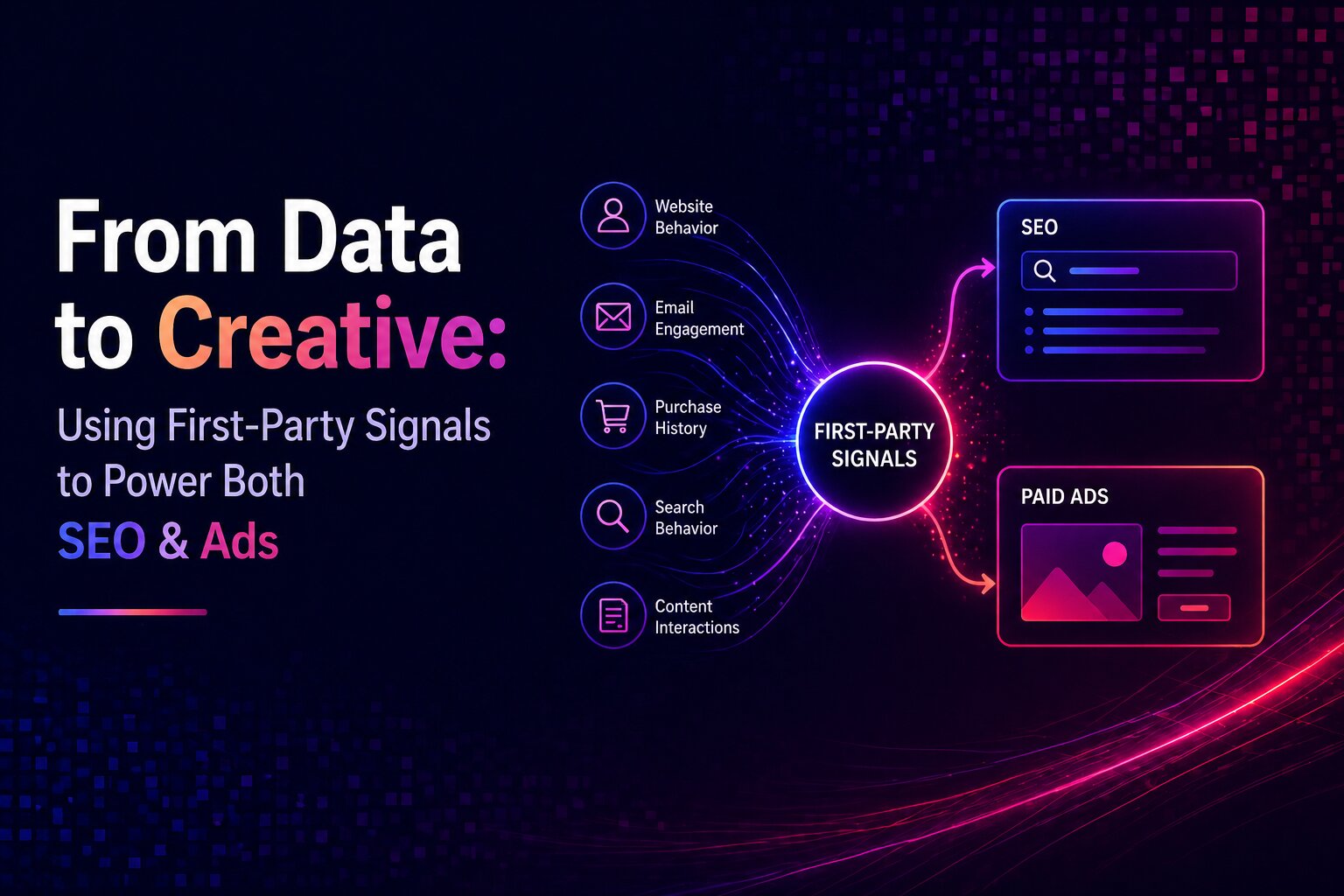
High-value first-party signals include:
- On-site behavior (pages viewed, depth, engagement)
- Search queries from Search Console
- Conversion paths and assisted interactions
- Content consumption patterns
- Form responses and lead quality
- Purchase history and lifecycle stage
- Logged-in user actions
- Server-side conversion events
These signals are:
- Privacy-compliant
- Consent-based
- Owned by the brand
And critically—they are shared truth across SEO and paid media.
Why First-Party Signals Matter More Than Ever
AI-driven platforms now optimize based on patterns, not individual tracking.
First-party data:
- Trains algorithms more accurately
- Reduces reliance on modeled guesses
- Improves relevance signals
- Aligns organic and paid strategy
When SEO and paid teams work from the same data foundation, performance compounds instead of fragmenting.
Turning First-Party SEO Data Into Paid Media Advantage
SEO teams sit on a goldmine of intent data—and too often, it stays siloed.
1. Use Organic Queries to Shape Paid Targeting
Search Console reveals:
- What users actually ask
- How language evolves over time
- Which topics generate demand before conversion
Paid teams can use this to:
- Prioritize high-intent keyword themes
- Inform broad match and smart bidding inputs
- Avoid spending on misaligned queries
Organic intent data reduces paid experimentation costs.
2. Let SEO Engagement Data Guide Creative Messaging
SEO content performance shows:
- Which angles resonate
- Which headlines earn attention
- Which explanations keep users engaged
These insights should directly inform:
- Ad copy
- Video hooks
- Value proposition framing
- Landing page structure
If content works without paid spend, it’s a strong signal for ad creative.
3. Identify Content That Assists Conversions
First-party analytics often reveal that:
- Informational content precedes conversions
- Certain guides or FAQs reduce friction
- Trust-building pages influence buying decisions
Paid teams can:
- Retarget users based on content interaction
- Align ad messaging with previously consumed content
- Shorten time-to-conversion
SEO becomes a conversion primer, not just a traffic source.
Using Paid Media Signals to Improve SEO Content
The feedback loop runs both ways.
Paid media produces fast, directional insights SEO can’t get alone.
1. Paid Conversion Data Reveals True Intent
Paid search and paid social quickly show:
- Which messages convert
- Which objections matter
- Which benefits accelerate decisions
SEO teams can use this to:
- Refocus content around high-conversion topics
- Improve commercial-intent pages
- Update informational content with stronger CTAs and proof points
Paid data helps SEO optimize for business outcomes, not just rankings.
2. Creative Performance Signals Guide Content Structure
If paid ads perform best when they:
- Lead with pricing transparency
- Highlight speed or ease
- Emphasize social proof
Then SEO content should mirror those priorities.
Consistency across paid and organic improves:
- Conversion rate
- Brand trust
- AI understanding of relevance
First-Party Data as the Bridge Between SEO & Ads
In an AI-driven ecosystem, platforms learn from coherent signals.
When SEO says one thing and paid says another:
- Algorithms get mixed messages
- Learning slows
- Efficiency drops
When both channels reinforce the same insights:
- AI optimizes faster
- CPA improves
- Organic visibility strengthens
- Paid performance stabilizes
First-party data is the shared language that makes this possible.
A Practical Framework: From Data to Creative
Step 1: Centralize First-Party Signals
- Combine SEO, analytics, CRM, and paid data
- Focus on trends, not isolated metrics
Step 2: Translate Data Into Insights
- What questions are users asking?
- What content do converters consume?
- Where do users hesitate or drop off?
Step 3: Turn Insights Into Creative
- SEO: content themes, headlines, structure
- Paid: hooks, messaging, offers, formats
Step 4: Close the Loop
- Feed paid performance back into content strategy
- Update SEO priorities based on conversion data
- Continuously refine both channels
Common Mistakes With First-Party Data Activation
❌ Treating Data as Reporting Only
Data should guide creation—not just measure it.
❌ Over-Segmenting Without Insight
More segments don’t equal better understanding.
❌ Letting SEO and Paid Interpret Data Separately
Shared data without shared interpretation still creates silos.
The Future: Creative Informed by Reality, Not Assumptions
As privacy-first measurement becomes the norm, first-party signals become the most honest reflection of your audience.
Brands that win in 2026 will:
- Build content from real questions
- Design ads from real behavior
- Align SEO and paid around shared truth
- Use data to inform creativity—not replace it
From data to creative, first-party signals aren’t just compliant.
They’re competitive advantage.
