
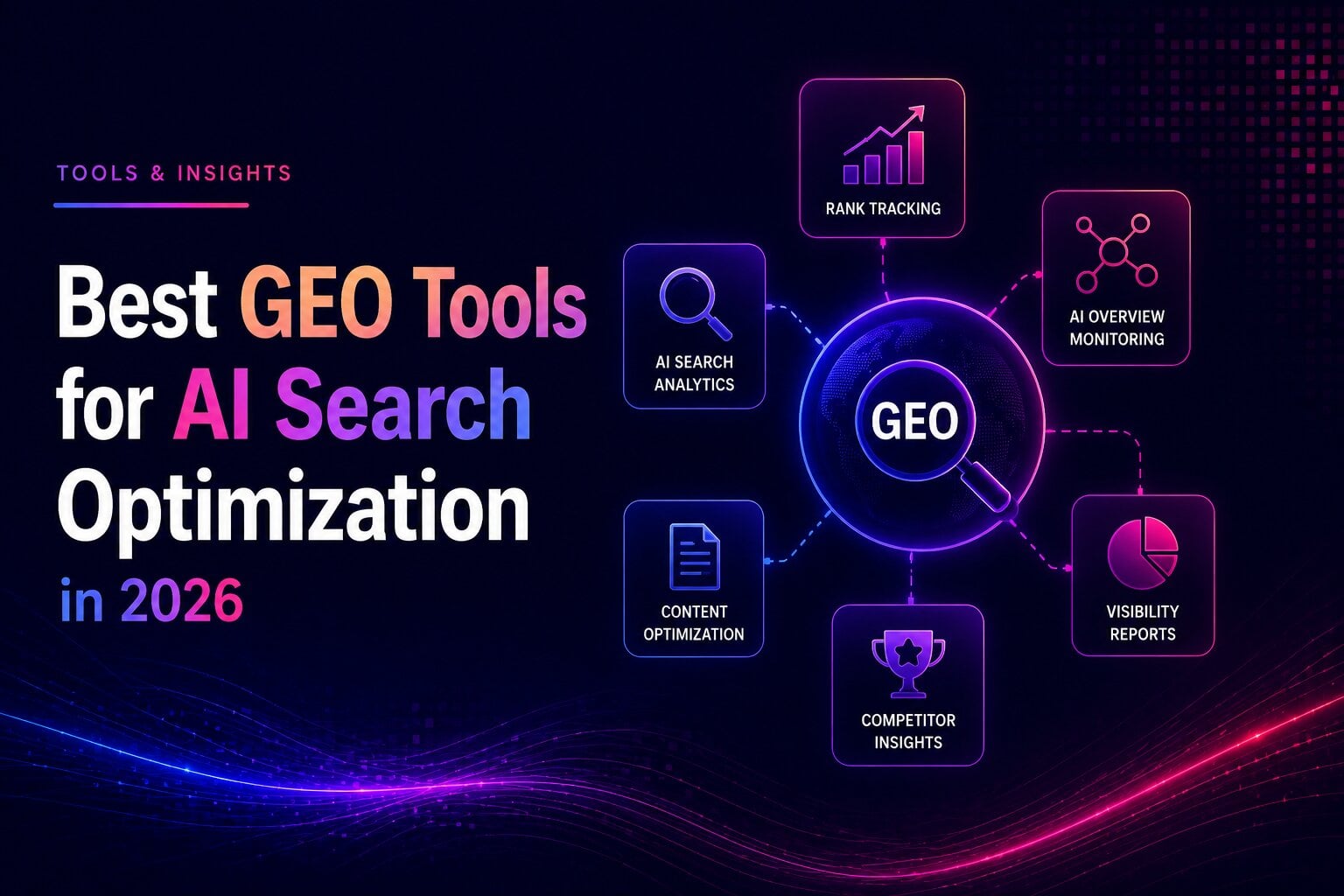
Search engine optimization is evolving fast.
In 2026, ranking on Google alone is no longer enough. Brands now need visibility across:
- AI search engines
- Generative answer platforms
- Conversational AI tools
- Large language model ecosystems
This shift has introduced a new discipline:
Generative Engine Optimization (GEO).
GEO focuses on optimizing content so AI systems can:
- Understand your brand
- Cite your content
- Reference your expertise
- Surface your website in AI-generated answers
As demand grows, a new category of platforms has emerged:
AI search optimization tools.
In this guide, we’ll cover the best GEO tools for AI search optimization in 2026, including what they do, who they’re best for, and how marketers should use them.
What Are GEO Tools?
GEO tools help businesses optimize content for AI-powered search environments rather than just traditional search engines.
These tools typically focus on:
- Entity optimization
- Structured data analysis
- AI visibility tracking
- Citation monitoring
- Semantic search optimization
- Conversational query analysis
- LLM content readiness
Unlike traditional SEO software, GEO platforms are designed for the AI-search ecosystem.
Why GEO Tools Matter in 2026
AI-generated search experiences are changing user behavior dramatically.
Users increasingly discover brands through:
- AI summaries
- Conversational answers
- Recommendation engines
- AI assistants
- Multi-source synthesized content
This means brands must optimize not only for rankings — but also for:
- Citations
- Mentions
- Entity recognition
- Contextual relevance
GEO tools help marketers understand how AI systems interpret their content.
1. Profound
Best For
Enterprise AI visibility tracking
Profound has emerged as one of the leading generative engine optimization software platforms in 2026.
It helps brands:
- Monitor AI citations
- Track LLM visibility
- Analyze brand mentions across AI systems
- Identify content gaps for AI search
Key Features
- AI citation tracking
- Entity visibility monitoring
- GEO reporting dashboards
- AI answer analysis
Why Marketers Like It
Profound focuses specifically on AI-search visibility rather than traditional rankings.
That makes it particularly useful for:
- Enterprise SEO teams
- Publishers
- SaaS brands
- Large content ecosystems
2. Semrush AI Toolkit
Best For
SEO teams transitioning into GEO workflows
Semrush has expanded aggressively into AI search optimization tools.
Its AI Toolkit now includes:
- AI visibility insights
- Conversational query analysis
- Entity-based keyword clustering
- AI-driven SERP tracking
Key Features
- Hybrid SEO + GEO reporting
- AI keyword opportunities
- Search intent mapping
- Competitive AI visibility analysis
Why It Works
Many businesses already use Semrush, making adoption easier.
It bridges traditional SEO and generative search optimization effectively.
3. Ahrefs AI Search Explorer
Best For
Content-driven SEO strategies
Ahrefs has started integrating AI visibility metrics into its ecosystem.
Its newer AI-focused reporting helps marketers understand:
- Which content gets cited
- Which pages AI systems prefer
- Entity relationships across topics
Key Features
- AI citation discovery
- Conversational keyword tracking
- Topic authority analysis
- Link-to-citation correlation
Ideal Use Cases
- Blog-driven SEO campaigns
- Topical authority strategies
- Content optimization workflows
4. Clearscope
Best For
Semantic content optimization
Clearscope remains one of the strongest tools for semantic SEO and content relevance.
As GEO evolves, semantic optimization becomes even more important because AI systems prioritize:
- Context
- Entity relationships
- Topical depth
- Natural language relevance
Key Features
- Semantic keyword recommendations
- NLP-driven optimization
- Readability scoring
- Topic coverage analysis
Why GEO Teams Use It
Well-structured semantic content is more likely to appear in AI-generated answers.
5. MarketMuse
Best For
Topical authority development
MarketMuse helps brands build comprehensive topic ecosystems.
This is extremely important for GEO because AI systems tend to favor:
- Trusted sources
- Deep topical expertise
- Comprehensive content coverage
Key Features
- Content gap analysis
- Authority scoring
- AI-assisted content planning
- Semantic optimization
Best Strategy
Use MarketMuse for building content clusters around:
- Industry expertise
- Entity authority
- AI-search relevance
6. Surfer SEO
Best For
On-page GEO optimization
Surfer SEO has adapted quickly to the AI-search era.
Its content optimization platform now supports:
- Conversational search structures
- NLP entity optimization
- AI-readable formatting
- Semantic scoring
Key Features
- Content editor
- NLP keyword analysis
- Heading structure recommendations
- Search intent optimization
Why It Matters
Formatting and structure increasingly affect how AI models parse content.
7. Perplexity Brand Monitoring Tools
Best For
AI citation monitoring
Brands increasingly want to know:
“Is AI mentioning us?”
Perplexity monitoring solutions help track:
- Citation frequency
- Source attribution
- AI-generated mentions
- Competitive visibility
This is becoming a major KPI for GEO campaigns.
What Features Matter Most in GEO Tools?
When evaluating AI search optimization tools, prioritize these features:
AI Citation Tracking
Can the tool identify where AI systems mention your brand?
Entity Optimization
Does it help improve semantic relationships and entity understanding?
Conversational Query Analysis
Can it analyze natural-language search behavior?
Structured Data Support
Schema markup remains critical for AI readability.
Multi-Platform Visibility
Modern GEO requires optimization beyond Google.
How GEO Differs From Traditional SEO
Traditional SEO focuses heavily on:
- Rankings
- Click-through rates
- Organic sessions
GEO expands the focus toward:
- AI citations
- Entity recognition
- Brand authority
- Contextual relevance
- Conversational discoverability
This requires a different optimization mindset.
The Future of Generative Engine Optimization
GEO is still early — but adoption is accelerating rapidly.
In the coming years, expect:
- Dedicated GEO dashboards
- AI citation benchmarks
- LLM optimization scoring
- AI search share-of-voice reporting
- Cross-platform AI visibility metrics
The brands investing early in GEO workflows will likely dominate AI-driven discovery ecosystems.
Final Thoughts
The rise of AI-powered search is fundamentally changing digital marketing.
Traditional SEO still matters — but it’s no longer enough on its own.
Businesses now need strategies built for:
- AI-generated answers
- Conversational discovery
- Entity-based relevance
- Cross-platform visibility
The best GEO tools in 2026 help marketers bridge that gap.
Whether you’re an enterprise SEO team, content marketer, or agency, investing in generative engine optimization software today can help future-proof your visibility for the next generation of search.
