
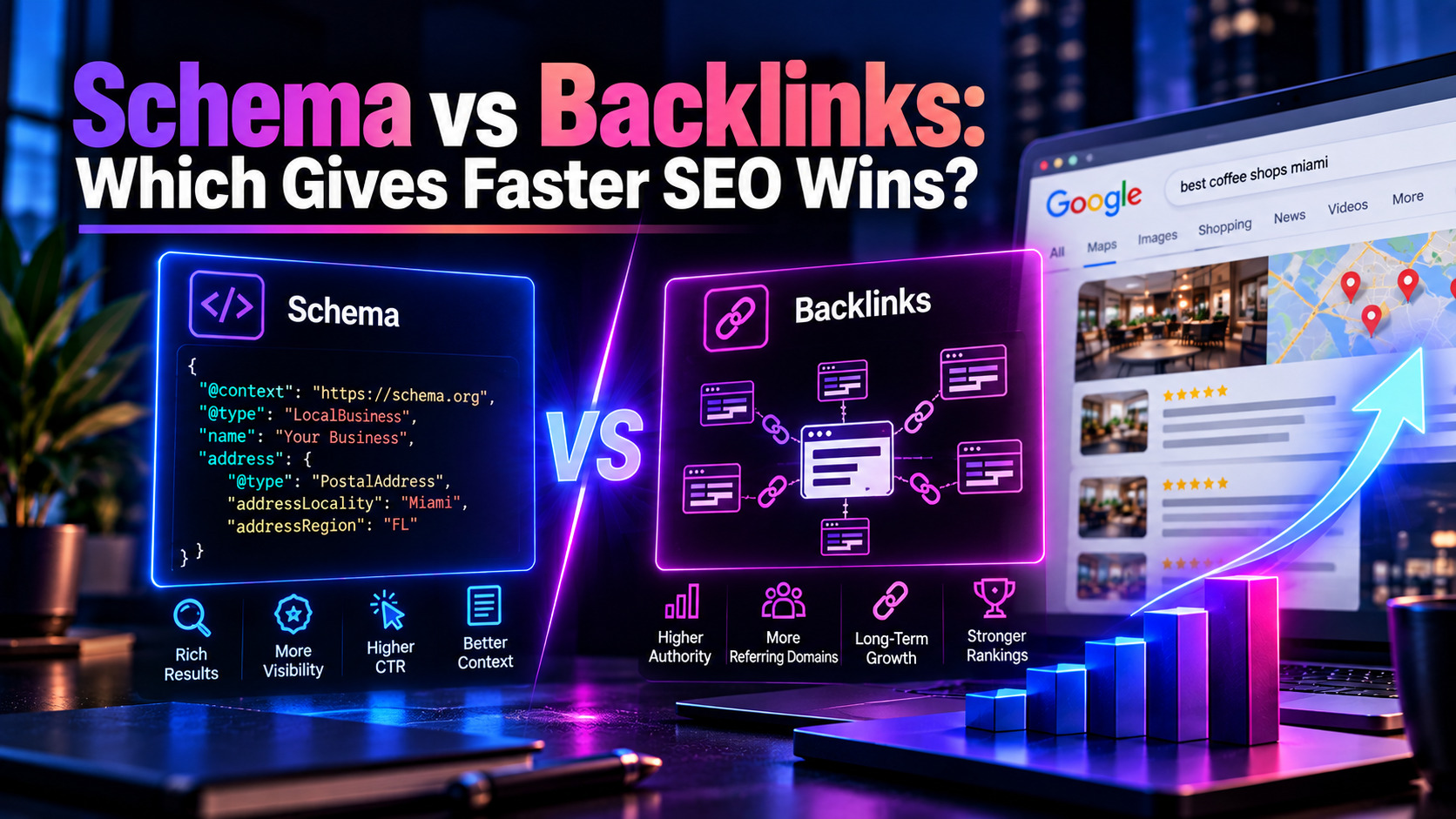
When it comes to SEO, businesses often have limited time and resources. That raises an important question: Should you invest in schema markup or focus on building backlinks first?
Both can play an important role in an SEO strategy, but they solve different problems. Schema markup helps search engines understand the content and entities on your website, while backlinks can contribute to your website’s authority, discovery, and visibility. So, which one gives faster SEO wins?
The answer depends on the condition of your website, your existing authority, and what you mean by an “SEO win.” Schema can often be implemented relatively quickly, while earning quality backlinks usually takes more time. However, neither should be viewed as a shortcut to guaranteed rankings.
In this guide, we’ll compare schema vs backlinks, explain how each works, and show you when to prioritize one over the other.
What Is Schema Markup?
Schema markup, also known as structured data, is code added to a webpage to help search engines better understand what the content represents. For example, a page could contain information about:
- A business
- A person
- A product
- A service
- An article
- An event
- A location
- A review
- Breadcrumb navigation
Schema gives search engines additional context about this information. For example, instead of simply seeing a phone number and address on a page, structured data can help identify that information as belonging to a particular business or location.
How Does Schema Markup Work?
The basic process looks like this:
Website Content → Structured Data → Search Engine Understanding → Potential Search Enhancements
Schema does not replace the content on your page. Instead, it provides additional machine-readable context. This is particularly useful when you have important entities, products, services, articles, or business information that you want search engines to understand clearly.
Does Schema Markup Improve Rankings?
This is where schema is often misunderstood. Adding schema markup does not automatically improve your Google rankings.
Structured data can help search engines understand your content and can make eligible pages capable of appearing with certain enhanced search features. However, implementing valid structured data does not guarantee that Google will display a rich result. That means schema should not be treated as a direct ranking shortcut.
Instead, think of schema as part of a broader technical and content SEO strategy.
If your website needs improvements across technical SEO, on-page optimization, content, and structured data, a broader SEO strategy from Nxt Era Marketing Team can help identify which areas should be prioritized.
What Are Backlinks?
A backlink is a link from another website to your website.
For example, if an industry publication writes an article about digital marketing and links to your website as a supporting resource, that link is a backlink. Backlinks are part of off-page SEO and can help search engines discover pages while also providing signals about the relationships and authority of websites.
However, not all backlinks have the same value. A relevant editorial link from a trusted website can be much more meaningful than a large number of unrelated or low-quality links.
Why Are Backlinks Important for SEO?
Backlinks can contribute to:
- Website authority
- Page discovery
- Referral traffic
- Industry credibility
- Brand exposure
- Organic search visibility
Backlinks can also help establish relationships between websites within the same industry or topic.
For example, a healthcare company receiving a relevant link from a respected healthcare publication is generally more contextually meaningful than receiving a link from an unrelated website.
Are All Backlinks Equal?
No.
A strong backlink strategy should focus on relevance, quality, and context, rather than simply trying to acquire as many links as possible. Potential sources of relevant backlinks include:
- Industry publications
- Local business organisations
- Professional associations
- Business partners
- Relevant blogs
- News websites
- Research publications
- Community organisations
- Digital PR campaigns
For local businesses, relevant local backlinks can also support broader local visibility. Our guide on Local SEO for Multi-Location Businesses explains how local backlinks can form part of a wider local search strategy.
Schema vs Backlinks: What’s the Difference?
Schema markup and backlinks both support SEO, but they operate in very different ways.
| Factor | Schema Markup | Backlinks |
| Main purpose | Help search engines understand content | Establish external connections and authority |
| Location | Your own website | External websites |
| Implementation | Technical/content task | Outreach, PR, partnerships, content promotion |
| Main benefit | Better understanding and potential search enhancements | Authority, discovery and referral traffic |
| Ranking impact | Not a guaranteed ranking boost | Can contribute to search visibility |
| Implementation speed | Often relatively quick | Usually takes longer |
| Level of control | High | Lower |
| Resources required | Technical implementation | Content, outreach and relationship building |
| Long-term value | Supports structured understanding | Can strengthen external authority |
The key point is that schema and backlinks are not direct substitutes for one another. Schema helps search engines interpret your website. Backlinks provide external signals and connections to your website. A strong SEO strategy can use both.
Which Gives Faster SEO Wins?
If you’re looking purely at implementation speed, schema will often be faster. A business can audit its existing structured data, correct errors, and implement appropriate schema without waiting for another website to agree to publish a link. Backlinks are different.
A typical link-building process might involve:
- Identifying relevant websites
- Creating useful content or resources
- Finding outreach opportunities
- Contacting website owners or editors
- Getting the content reviewed
- Earning the link
- Waiting for search engines to discover and process the change
That can take considerably longer. However, faster implementation does not necessarily mean greater SEO impact.
Schema Can Be a Quick Technical Improvement
Suppose your website has important pages with missing or incorrectly implemented structured data. You may be able to correct those issues relatively quickly.
For example, a local business could implement appropriate structured data to help search engines understand information about its business, services, and location. The potential benefit is improved machine-readable understanding and eligibility for supported search features. But there is an important distinction:
Implementing the schema is immediate. Seeing a measurable SEO outcome is not guaranteed or necessarily immediate.
Backlinks Are Usually a Longer-Term Investment
Building quality backlinks requires earning attention from other websites. That makes the process less predictable. You could publish an excellent resource and earn several links quickly, or you could conduct dozens of outreach campaigns before securing a relevant editorial placement. The quality of the links also matters.
The goal shouldn’t be:
“How many backlinks can we get?”
A better question is:
“Which relevant websites would make our content more credible and useful to their audience?”
When Should You Prioritize Schema?
Schema should be considered a priority when:
- Your website has little or no structured data
- Existing structured data contains errors
- Important pages lack appropriate markup
- Your business, services, products, or articles aren’t clearly represented
- You want to improve machine-readable understanding of your content
- Your pages may be eligible for supported search enhancements
- Your technical SEO foundation is otherwise healthy
Schema is particularly useful when you already have good content but need to improve how that information is communicated to search engines.
Example
Imagine a local dental clinic has a well-optimized service page containing:
- Service information
- Business information
- Location
- Contact details
- Opening hours
- FAQs
Appropriate structured data can help search engines better interpret these entities and relationships. However, the markup should accurately represent information that is actually present on the page.
When Should You Prioritize Backlinks?
Backlinks may deserve greater attention when your website already has a solid technical foundation and high-quality content, but competitors have significantly stronger external authority. Consider prioritizing link acquisition when:
- Your technical SEO is healthy
- Your content satisfies search intent
- Your competitors have stronger referring-domain profiles
- Important pages have few relevant external links
- You have useful content worth referencing
- You can build relationships within your industry
- You have opportunities for digital PR
Good link-building opportunities might come from original research, industry guides, partnerships, expert contributions, local organisations, and news coverage. The emphasis should always be on earning relevant links rather than manufacturing links at scale.
What If You Need Quick SEO Wins?
If you’re looking for quick SEO improvements, don’t automatically start with schema or backlinks. Start with the fundamentals.
Step 1: Fix Technical SEO Issues
Check:
- Indexability
- Crawlability
- Canonical tags
- Broken links
- Redirects
- Mobile usability
- Page speed
- XML sitemap
- Robots.txt
Technical problems can prevent search engines from properly accessing or processing your pages in the first place. Nxt Era Marketing Team SEO Services include improvements to areas such as site speed, mobile-friendliness, and crawlability.
Step 2: Improve On-Page SEO
Review:
- Search intent
- Page titles
- H1
- Headings
- Content quality
- Keyword targeting
- Internal links
- Image optimization
- Meta descriptions
A technically perfect page won’t necessarily perform well if it doesn’t satisfy what users are searching for.
Step 3: Implement Appropriate Schema
Once the page itself is strong, make sure appropriate structured data is implemented correctly. Don’t add schema simply because it is available. Use markup that accurately represents the content on the page.
Step 4: Build External Authority
Once your website has a strong foundation, develop a sustainable strategy for earning relevant backlinks.
This can include:
- Digital PR
- Industry partnerships
- Original research
- Expert content
- Guest contributions
- Resource pages
- Local partnerships
This four-step approach is generally more useful than treating schema and backlinks as isolated SEO tactics.
Schema vs Backlinks: What Should Small Businesses Do First?
The answer depends on the current condition of the website.
If You Have a New Website
Start with the fundamentals:
Technical SEO → Content → On-Page SEO → Schema → Authority Building
A new website needs a strong foundation before investing heavily in external authority.
If You Have Strong Content but Low Authority
If your website already has useful, well-optimized content but lacks external authority, backlink acquisition may deserve more attention. Look for relevant opportunities through:
- Industry publications
- Local organisations
- Business partners
- Digital PR
- Expert contributions
If Your Website Has Technical Problems
Fix the technical foundation first. A suggested order is:
Technical SEO → Indexability → On-Page SEO → Schema → Link Building
There is little value in aggressively building backlinks to pages that search engines cannot properly crawl or index.
If Your Website Already Has Strong Authority
Your next opportunity may not be backlinks. Instead, investigate:
- Content gaps
- Search intent
- Internal linking
- Schema
- CTR opportunities
- Keyword targeting
- Underperforming pages
- Conversion opportunities
The right SEO priority depends on what is holding the website back.
How Schema and Backlinks Work Together
The best approach isn’t necessarily schema vs backlinks.
It’s schema + backlinks + strong SEO fundamentals.
Think of the roles this way:
Technical SEO
Makes your website accessible and crawlable.
Content
Provides useful information that satisfies search intent.
Schema
Helps search engines understand the information and entities on your pages.
Backlinks
Provide external connections, authority signals, and potential referral traffic.
Together, they create a more complete SEO ecosystem.
For example:
A business publishes an in-depth guide → optimizes the page for search intent → adds appropriate structured data → internally links related content → promotes the resource → earns relevant backlinks.
That is a much stronger process than simply adding schema or purchasing links and expecting rankings to change.
How Long Does It Take to See SEO Results?
There is no universal timeline for SEO.
The time required can depend on:
- Website authority
- Competition
- Industry
- Search demand
- Content quality
- Technical health
- Quality of implementation
- Existing rankings
- Search engine crawling and processing
Schema
Schema can often be implemented relatively quickly. However, implementation and results are two different things. Search engines still need to crawl and process the page, and eligibility for enhanced search features does not guarantee that those features will appear.
Backlinks
Backlinks generally take longer because they must first be earned. Even after a backlink is published, its SEO impact may not be immediate. This is why link building should generally be treated as a long-term authority-building activity rather than a guaranteed short-term ranking tactic.
How to Measure Schema vs Backlinks
The best way to determine whether an SEO activity is working is to measure the right outcomes.
Schema Metrics
Monitor:
- Rich result eligibility
- Search Console enhancement reports
- Search appearance
- Impressions
- Organic clicks
- CTR
- Landing-page performance
The goal isn’t simply to count how much schema you have implemented. The goal is to determine whether your structured-data improvements contribute to better search understanding or eligible search experiences.
Backlink Metrics
Monitor:
- Referring domains
- Relevant backlinks
- Link quality
- Referral traffic
- Target-page performance
- Organic visibility
- Organic traffic
- Conversions
Don’t judge a backlink campaign solely by the number of links acquired. One highly relevant editorial link may be more valuable to your strategy than dozens of unrelated links.
Common Schema and Backlink Mistakes
Adding Schema Just for Rankings
Schema does not guarantee higher rankings.
Use structured data to accurately describe your content and eligible entities.
Building Large Numbers of Low-Quality Links
More backlinks do not automatically mean better SEO.
Focus on relevance, quality, and legitimate acquisition.
Using Schema That Doesn’t Match the Page
Structured data should accurately represent the visible content and entities on the page.
Building Links Before Fixing Technical Problems
If your website has serious crawlability, indexability, or technical issues, address those problems first.
Measuring SEO Only Through Rankings
Rankings are useful, but they aren’t the only metric that matters.
Also monitor:
- Impressions
- Clicks
- CTR
- Organic traffic
- Leads
- Conversions
- Referring domains
- Search visibility
So, Which Is Faster: Schema or Backlinks?
If the question is purely about implementation speed, schema can usually be implemented faster than earning quality backlinks. But that doesn’t mean schema will always produce a faster or larger SEO improvement. Schema and backlinks have different purposes.
Schema helps search engines understand your website.
Backlinks can help build external authority and discoverability.
Your website may need one, both, or neither as the immediate priority depending on its current SEO condition. The better question isn’t:
“Should I choose schema or backlinks?”
It’s:
“What is currently limiting my website’s search visibility?”
If the problem is technical or structural, fix the website first. If the site has strong content but lacks authority, investigate relevant link-building opportunities. If the content is already strong and technically sound, schema may be one of several useful optimization opportunities.
FAQs About Schema and Backlinks
Is schema markup more important than backlinks?
Neither is universally more important. Schema and backlinks serve different functions within SEO. Schema helps search engines understand content, while backlinks can contribute to external authority and discovery.
Can schema markup improve Google rankings?
Schema markup does not guarantee higher rankings. It can help search engines understand page content and may make eligible pages capable of appearing with supported search enhancements.
Do backlinks still matter for SEO?
Backlinks can contribute to SEO by providing external connections, authority signals, discovery opportunities, and referral traffic. Their value depends heavily on relevance and quality.
How quickly can schema markup show results?
Schema can be implemented quickly, but the resulting search changes are not guaranteed or necessarily immediate. Search engines need to crawl and process the page, and eligibility does not guarantee a particular search appearance.
How long does it take to build effective backlinks?
It varies significantly. Some links can be earned quickly, while others may take weeks or months through content promotion, outreach, PR, or relationship building.
Should a new website focus on backlinks or schema?
A new website should generally establish a strong technical and content foundation first. Appropriate schema and sustainable authority building can then become part of the broader SEO strategy.
Can schema and backlinks work together?
Yes. Schema and backlinks address different aspects of SEO and can be used together as part of a broader strategy.
How many backlinks does a website need?
There is no universal number. The more useful question is whether your website has enough relevant authority to compete for its target searches. Quality and relevance are more useful considerations than chasing a specific backlink count.
What should I fix first for SEO?
Start by identifying the biggest constraint. Check technical SEO, indexability, content quality, search intent, internal linking, and authority before deciding which individual tactic deserves priority.
Final Takeaway
Schema and backlinks aren’t competing SEO strategies. They solve different problems.
Schema can be relatively quick to implement and can help search engines better understand eligible content. Backlinks can strengthen external authority and provide additional discovery and referral opportunities, but quality links generally take more time to earn.
For most websites, a practical SEO process looks like this:
Fix technical SEO → Improve content → Optimize on-page elements → Implement appropriate schema → Build relevant authority → Measure and refine
The fastest SEO win isn’t always the tactic that can be implemented fastest. It’s the improvement that addresses the biggest limitation on your website.
If you’re unsure whether your website needs technical SEO improvements, schema optimization, stronger content, or backlink building, Nxt Era Marketing Team SEO Services can help identify the opportunities that should be prioritized.
Ready to find your biggest SEO opportunities? Get in touch with Nxt Era Marketing Team and build a strategy around what your website actually needs.
