
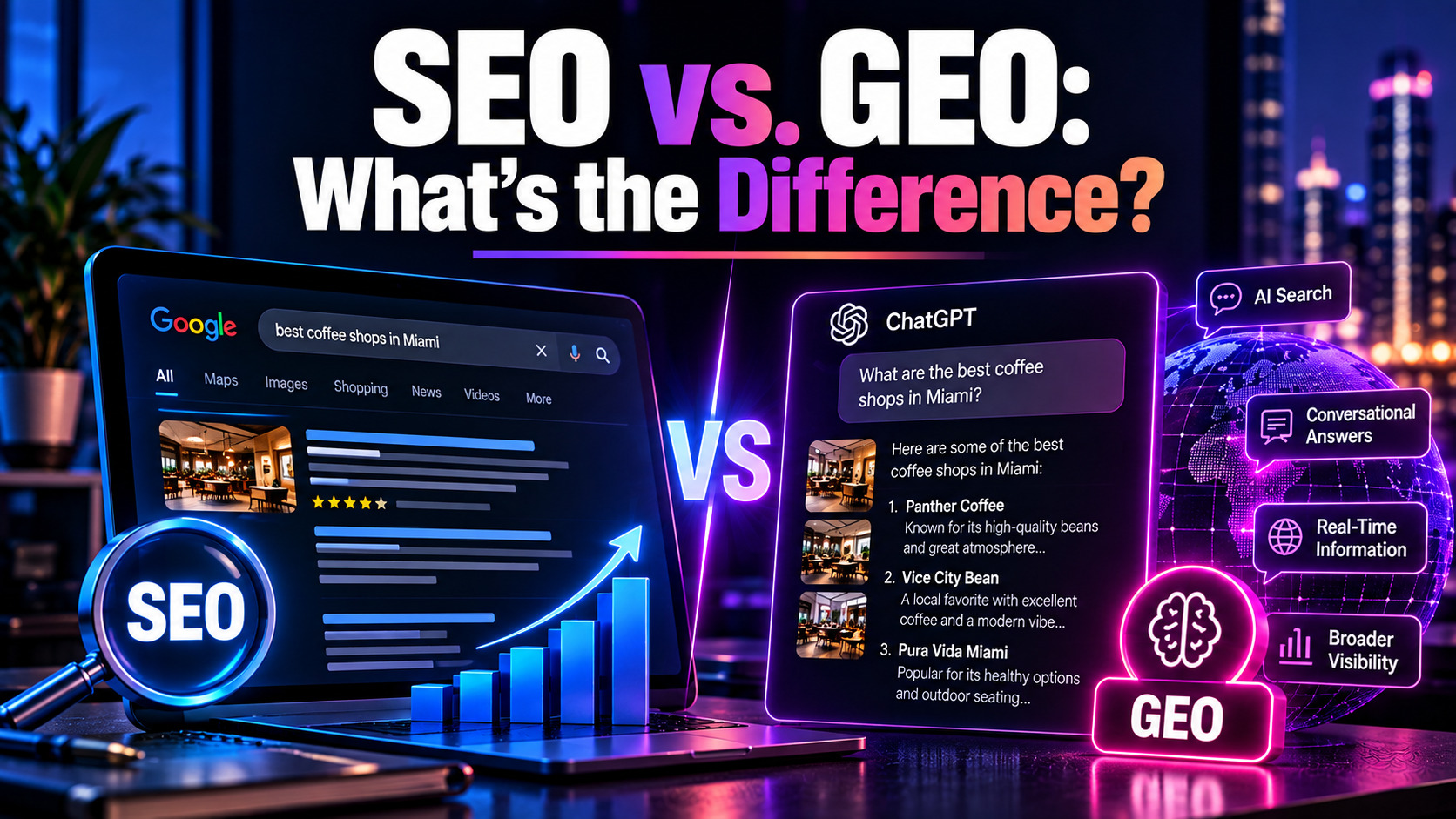
Search is changing. For years, businesses focused primarily on ranking their websites on Google. The goal was straightforward: appear higher in search results, earn clicks, generate organic traffic, and turn that traffic into leads or customers.
Today, people can also ask questions directly through AI-powered search experiences and receive synthesized answers with links to supporting sources. That creates a new question for businesses and marketers:
Should you focus on SEO, GEO, or both?
SEO and GEO are closely related, but they focus on different aspects of search visibility. SEO helps your website perform in traditional search, while GEO focuses on making your content easier for generative AI systems to discover, understand, use, and potentially cite.
The good news is that you don’t necessarily need two completely separate strategies. In fact, many of the fundamentals that make a website strong for SEO also support visibility in AI-powered search.
What Is SEO?
SEO, or Search Engine Optimization, is the process of improving a website so that search engines can discover, understand, and rank its pages for relevant searches.
A simplified SEO process looks like this:
Crawl → Index → Understand → Rank → Click
Search engines crawl your website, process and index its pages, interpret the content and its relevance, and then determine which results to show for different searches.
SEO can involve many different activities, including:
- Keyword research
- Search intent analysis
- On-page optimization
- Technical SEO
- Content creation
- Internal linking
- Backlink building
- Website structure
- User experience
- Local SEO
- Conversion optimization
For example, if a business provides SEO services in the Philippines, its SEO strategy might target searches related to:
- SEO services Philippines
- SEO agency Philippines
- local SEO services
- technical SEO services
- SEO consultant Philippines
The objective is not simply to rank for keywords. The larger goal is to attract people who are searching for products, services, information, or solutions that the business provides.
What Is the Goal of SEO?
Traditional SEO generally focuses on improving visibility and performance in search results.
Common SEO goals include:
- Improving keyword rankings
- Increasing organic clicks
- Growing organic traffic
- Increasing search visibility
- Generating qualified leads
- Increasing conversions
- Building long-term website authority
SEO remains important even as search becomes more AI-driven.
Google’s current guidance states that its AI Overviews and AI Mode are built on its existing Search systems, meaning foundational SEO practices remain relevant for these AI experiences as well.
If you’re looking at the broader fundamentals behind organic visibility, Nxt Era Marketing Team’s SEO services cover areas such as content, website structure, technical SEO, speed, and visibility.
What Is GEO?
GEO stands for Generative Engine Optimization.
GEO is commonly used to describe the process of improving content so that generative AI and AI-powered search systems can discover, understand, retrieve, summarize, reference, or potentially cite that information in generated answers.
Instead of thinking only about:
“How do I rank #1 for this keyword?”
GEO introduces another question:
“How can my content become a useful source when someone asks an AI system this question?”
A simplified GEO process can be represented as:
Search/Prompt → Retrieval → Content Selection → AI-Generated Answer → Citation or Brand Mention
For example, someone might ask:
“What are the best ways to improve local SEO for a small business?”
An AI-powered search experience may analyze information from multiple sources and generate a response. If your content is relevant, accessible, trustworthy, and useful, it may have an opportunity to be referenced or linked.
However, GEO should not be treated as a guaranteed method for getting your website cited by AI.
AI systems use different technologies, data sources, retrieval systems, and ranking processes. Visibility can therefore vary by platform and query.
How GEO Differs From Traditional SEO
Traditional SEO often focuses heavily on:
Keyword → Search Result → Click
GEO places more emphasis on:
Question → Information Retrieval → Answer → Source/Citation
That doesn’t mean keywords suddenly become irrelevant.
It means content needs to answer the broader information need behind a query.
Where Does GEO Apply?
GEO can be relevant across different AI-powered search and answer experiences, including:
- ChatGPT Search
- Google AI Overviews
- Google AI Mode
- Microsoft Copilot
- Perplexity
- Other generative search experiences
The exact way these systems retrieve and present information varies.
For example, Google explains that AI Overviews and AI Mode can use multiple searches and sources to develop responses and provide links to supporting websites.
OpenAI also states that publicly accessible websites can appear in ChatGPT Search, and publishers that want their content to be discoverable through ChatGPT Search should avoid blocking OAI-SearchBot.
This creates another opportunity for businesses to think beyond traditional rankings and consider how their information is represented across the evolving search ecosystem.
SEO vs GEO: What’s the Difference?
SEO and GEO overlap considerably, but their primary goals and environments can differ.
| Factor | SEO | GEO |
| Primary goal | Improve search visibility and rankings | Increase visibility within AI-generated answers |
| Main environment | Traditional search engines | Generative AI and AI-powered search |
| Main output | Search result | AI-generated answer and potential citation |
| Optimization focus | Pages and websites | Information, content passages, entities and sources |
| Keywords | Important | Still useful, but conversational context matters |
| Search intent | Important | Important |
| Technical SEO | Essential | Still important |
| Backlinks | Can contribute to authority | Can contribute to discoverability and authority |
| Content structure | Important | Particularly useful for clear information retrieval |
| Main metrics | Rankings, clicks, traffic, conversions | AI visibility, citations, mentions, referrals |
| User journey | Search → Result → Website | Prompt → AI Answer → Source/Website |
The important thing is not to treat SEO and GEO as completely separate disciplines.
Google’s own guidance reinforces this point: the foundational SEO practices that have long been recommended remain relevant to AI features in Search. Google also states that there are no additional technical requirements or special schema required specifically for AI Overviews or AI Mode.
So rather than abandoning SEO and starting again with GEO, businesses can build on what they already have.
SEO vs GEO: What Do They Have in Common?
One of the biggest misconceptions about GEO is that businesses need to completely rewrite their SEO strategy.
They don’t.
Many of the fundamentals overlap.
High-Quality Content
Both SEO and GEO depend on useful information.
Content should be:
- Accurate
- Relevant
- Original
- Helpful
- Well researched
- Written for the intended audience
Google specifically recommends creating unique, valuable content for people when optimizing for its AI search experiences. The goal shouldn’t be to create content that simply contains as many keywords or AI-friendly phrases as possible. The goal should be to provide information that actually helps the reader.
Search Intent
Understanding why someone is searching remains important. Consider the difference between:
“SEO” and “How much does SEO cost for a small business?”
The second query reveals much more about the user’s information need. Good SEO and GEO strategies both require businesses to understand the questions, problems, comparisons, and decisions behind searches.
Technical Accessibility
Your content cannot be useful to search systems if they cannot properly access or process it. Important technical considerations include:
- Crawlability
- Indexability
- Website architecture
- Internal links
- Page experience
- Mobile usability
- Canonicalization
- Structured data where appropriate
- XML sitemap
- Robots.txt
Google’s AI search guidance specifically recommends ensuring that important content is accessible, indexable, and available in textual form.
Authority and Trust
AI search doesn’t eliminate the importance of credibility. Businesses should demonstrate expertise through:
- Original research
- First-hand experience
- Case studies
- Expert authorship
- Data
- References
- Clear business information
- Useful resources
The goal is to become a credible source rather than simply trying to generate more content.
Clear Website Structure
A well-organized website makes it easier for users and search systems to understand relationships between topics. For example:
SEO
↓
Technical SEO
↓
On-Page SEO
↓
Keyword Research
↓
Content Optimization
A logical structure can also support internal linking and topical coverage. Nxt Era’s own SEO content strategy can benefit from this approach by connecting related topics such as SEO, technical SEO, content strategy, local SEO, and AI search.
How GEO Changes the Way You Create Content
GEO doesn’t mean writing content specifically for robots. Instead, it encourages marketers to make important information clear, structured, accessible, and easy to understand.
Write Direct Answers
Don’t make readers search through five paragraphs to find the answer to a simple question. For example:
What Is Generative Engine Optimization?
Generative Engine Optimization is the process of improving online content so AI-powered search and answer systems can discover, understand, retrieve, and potentially reference that information in generated responses.
Then provide additional context below the answer. This structure works well because it gives users the information they need quickly while still allowing you to provide depth.
Build Content Around Questions
People don’t always search using short keywords. They ask complete questions.
Examples include:
- What is GEO?
- How is GEO different from SEO?
- Does GEO replace SEO?
- How does AI search work?
- How can I optimize my website for AI search?
- How can my business appear in ChatGPT?
- How do I improve my AI search visibility?
These questions can become:
- Blog posts
- FAQ sections
- Guides
- Service-page sections
- Comparison articles
- Supporting content
This also creates opportunities to build topical clusters rather than producing isolated articles. For example:
SEO
→ SEO Strategy
→ Technical SEO
→ Local SEO
→ Content SEO
→ AI SEO
→ GEO
→ AI Search Visibility
Nxt Era already publishes SEO-focused educational content, including articles on building topical maps for SEO, which fits naturally into this type of topical strategy.
Use Clear Content Structures
Make important information easy to identify. Useful formats include:
- H2 and H3 headings
- Short paragraphs
- Bullet points
- Tables
- Definitions
- FAQs
- Step-by-step processes
- Statistics
- Examples
- Case studies
This doesn’t mean every page needs to follow the exact same template. The structure should fit the topic and audience. Google specifically notes that there is no ideal page length for generative AI search. Content should be created for the audience rather than artificially shortened or expanded for AI systems.
Strengthen Entity and Topic Relationships
Search is increasingly about understanding entities and relationships, not just matching individual keywords. A business can make its subject matter clearer by consistently connecting:
Brand → Service → Industry → Location → Expertise → Related Topics
For example:
Nxt Era Marketing Team → SEO → GEO → AI Search → Digital Marketing → Philippines
This gives users and search systems more context about what the business does and the topics it covers.
How to Optimize for Both SEO and GEO
Instead of creating separate strategies for every search environment, build a content strategy that supports both.
1. Start With Search Intent
Before creating a page, identify:
- Primary keyword
- Related searches
- Questions
- User problems
- Informational intent
- Commercial intent
- Transactional intent
Then determine what the user actually needs from the page. A keyword alone isn’t enough.
2. Build Topically Relevant Content
Create a connected content ecosystem.
This can include:
- Pillar pages
- Supporting blog posts
- FAQs
- Guides
- Case studies
- Service pages
- Comparison articles
- Original research
For example, a digital marketing agency could create a pillar page about SEO and support it with content covering:
- Technical SEO
- Local SEO
- Link building
- Content SEO
- Schema markup
- SEO reporting
- GEO
- AI search
This gives the website broader topical coverage.
3. Make Important Information Easy to Extract
Use clear formats such as:
- Direct answers
- Definitions
- Lists
- Tables
- Statistics
- Examples
- Clear headings
For example:
Question: Does GEO replace SEO?
Short answer: No. GEO expands search optimization into AI-generated search experiences, while traditional SEO remains foundational.
Then explain the details. This approach benefits users first while also creating clearly structured information.
4. Demonstrate Expertise
Don’t rely entirely on generic information that can be found on hundreds of other websites.
Add:
- First-hand experience
- Case studies
- Original research
- Proprietary data
- Expert commentary
- Examples
- Client results where appropriate
- Sources and references
The more useful and original the content, the more reason there is for people and websites to reference it.
5. Strengthen Internal Linking
Internal links help users discover related information while helping search engines understand the relationship between pages.
For example:
SEO Services
→ Technical SEO
→ Content Strategy
→ Local SEO
→ SEO Audits
→ GEO
→ AI Search
Don’t add internal links simply for the sake of adding them. Link when the destination genuinely provides additional information.
6. Maintain Strong Technical SEO
Don’t neglect the technical foundation.
Check:
- Crawlability
- Indexability
- Page speed
- Mobile usability
- Canonicals
- Structured data
- Internal links
- XML sitemap
- Robots.txt
- HTTP status codes
Google specifically recommends many of these same fundamentals for sites seeking visibility in AI features.
One important clarification: you don’t need to create special AI markup or an llms.txt file just to appear in Google’s AI Overviews or AI Mode. Google’s current guidance says there is no special schema.org markup required for those features.
For ChatGPT Search, OpenAI separately states that publishers should avoid blocking OAI-SearchBot if they want their content to be discoverable and potentially included in search results.
How to Measure SEO vs GEO Performance
One of the biggest differences between traditional SEO and GEO is how businesses think about measurement.
SEO Metrics
Traditional SEO reporting can include:
- Organic traffic
- Organic clicks
- Impressions
- Average position
- CTR
- Keyword rankings
- Leads
- Conversions
These metrics help determine whether your website is becoming more visible and whether that visibility is producing business results.
GEO Metrics
GEO measurement can include:
- AI citations
- Brand mentions
- AI search visibility
- Citation frequency
- AI referral traffic
- Pages appearing in AI answers
- Questions where your brand is referenced
However, GEO measurement is still evolving. There isn’t one universal metric that can fully represent AI visibility across every platform.
Google has also introduced dedicated reporting for visibility within generative AI features in Search Console, including AI Overviews and AI Mode, with the rollout reaching websites worldwide by August 31, 2026.
This makes it increasingly possible to analyze AI search visibility alongside traditional organic performance. The important thing is to connect visibility metrics to actual business outcomes.
For example:
AI Mention → Website Visit → Engagement → Lead → Conversion
is more meaningful than simply counting mentions.
Does GEO Replace SEO?
No. GEO does not replace SEO. It expands the search visibility conversation into AI-generated answers and other generative search experiences. Google’s current documentation is particularly clear on this point: its AI features are built on existing Search systems, and SEO best practices remain relevant.
That means businesses don’t need to abandon:
- Technical SEO
- Keyword research
- Search intent
- Content optimization
- Internal linking
- Website architecture
- Authority building
Instead, they should make these fundamentals work alongside content that is clear, useful, authoritative, and easy to understand. A simple way to think about it is:
SEO foundation + GEO considerations = broader search visibility
SEO vs GEO: Which One Does Your Business Need?
The answer depends on your goals.
If Your Goal Is Traditional Google Traffic
Focus heavily on:
- SEO
- Keyword targeting
- Search intent
- Technical SEO
- Content optimization
- Internal linking
- Organic CTR
- Search rankings
These remain important foundations.
If Your Goal Is AI Search Visibility
Add greater emphasis to:
- Conversational questions
- Clear answers
- Entity relationships
- Structured information
- First-hand expertise
- Original research
- Citation-worthy content
- Brand visibility
But remember that there is no guaranteed formula for appearing in AI-generated answers.
If You Want Long-Term Search Visibility
Use both SEO and GEO considerations as part of the same content strategy. Don’t build two completely disconnected systems. Instead, create content that can:
- Be discovered by search engines
- Be understood by search systems
- Satisfy users
- Build topical authority
- Earn external references
- Potentially be surfaced or cited in AI experiences
The Future of Search Is Not SEO vs GEO
The search experience is becoming more diverse. A simplified evolution looks like:
Traditional Search → Search Features → AI Overviews → AI Search → Conversational Discovery
But this doesn’t mean traditional search is disappearing overnight. Instead, users increasingly have multiple ways to discover information. Someone might:
- Search Google for a service
- Ask an AI tool for recommendations
- Compare providers through an AI search experience
- Click a cited source
- Visit a company’s website
- Search the brand directly
- Return later through another channel
This means businesses should think about search visibility as a broader ecosystem.
Rather than asking:
“Should we do SEO or GEO?”
A better question is:
“How can we create content that is useful across the different ways people discover information?”
That’s where the overlap between SEO and GEO becomes valuable.
FAQs About SEO and GEO
Is GEO the same as SEO?
No. SEO focuses on improving visibility in search engines, while GEO focuses on optimizing content for generative AI and AI-powered search experiences. However, they share many foundational practices.
Is GEO replacing SEO?
No. Current Google guidance states that traditional SEO best practices remain relevant to its AI search experiences.
Is GEO the same as AI SEO?
The terms are sometimes used interchangeably, but there can be differences in how practitioners define them. AI SEO is often used as a broader term for optimizing websites and content for AI-driven search, while GEO specifically focuses on generative engine visibility.
How does GEO work?
GEO focuses on making information clear, relevant, authoritative, accessible, and useful to systems that retrieve information and generate answers. There is no single guaranteed GEO formula because different AI platforms use different systems.
How can I optimize my website for AI search?
Start with strong SEO fundamentals. Make sure your website is crawlable and indexable, create helpful and original content, answer relevant questions clearly, build topical authority, strengthen internal linking, and maintain accurate business information.
Google specifically recommends continuing to follow its established SEO best practices for AI features in Search.
Does SEO help with GEO?
Yes. Many SEO fundamentals also support AI search visibility. Google explicitly states that SEO best practices remain relevant to its AI search experiences.
Can small businesses benefit from GEO?
Yes. Small businesses can create useful, focused content around the specific questions their customers ask. Local expertise, first-hand experience, original information, and clearly presented services can help establish topical relevance.
How do you measure GEO?
Depending on the platform, businesses can monitor AI citations, brand mentions, AI visibility, referral traffic, and the pages or topics appearing in AI-generated responses. Google now also provides dedicated reporting for generative AI features in Search Console.
Can a website rank on Google but not appear in AI answers?
Yes. Traditional search rankings and AI-generated answers are not identical experiences. AI systems may select, combine, or summarize information differently depending on the query and retrieval process.
How long does GEO take to work?
There is no guaranteed timeline. AI visibility depends on factors such as crawling, indexing, content quality, relevance, authority, query context, and the systems used by each platform.
Final Takeaway
SEO and GEO aren’t competing strategies. SEO helps your website become discoverable and visible in traditional search results. GEO focuses on making your content useful and discoverable within generative AI and AI-powered search experiences.
The strongest approach is not to abandon SEO and chase every new AI search trend. Instead, build a strong SEO foundation and make your content:
- Helpful
- Accurate
- Original
- Well structured
- Easy to understand
- Technically accessible
- Supported by expertise
- Connected through relevant internal links
- Worth referencing
In other words:
Build for people first. Optimize for search. Make your information easy for AI systems to understand.
As search continues to evolve, businesses that invest in strong content, technical foundations, topical authority, and clear information will be better positioned to adapt across both traditional and AI-powered search experiences.
If you’re looking to improve your visibility across Google and AI search, Nxt Era Marketing Team’s SEO services can help you build a strategy around your website, audience, and search opportunities.
Ready to prepare your website for the next era of search? Talk to Nxt Era Marketing Team about your SEO and GEO strategy.
