
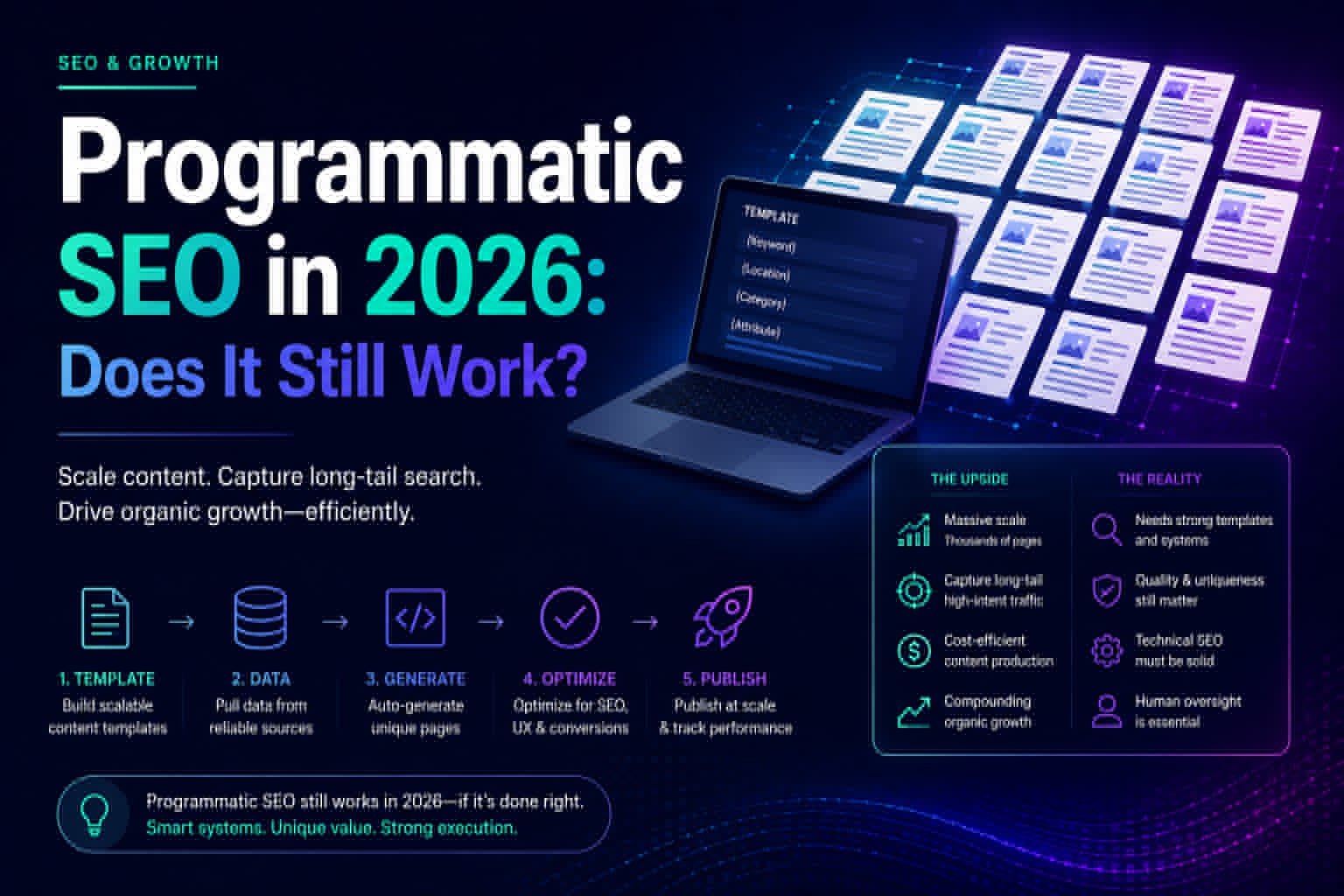
Programmatic SEO has been one of the biggest growth strategies for SaaS companies, marketplaces, directories, and startups over the last decade.
Companies like Zapier, Canva, HubSpot, Wise, and Yelp have used programmatic SEO to generate millions of monthly visitors through scalable content pages.
But with Google continually refining its algorithms and AI-powered search changing how users discover information, many marketers are asking an important question:
Does programmatic SEO still work in 2026?
The short answer is yes—but only when done correctly.
Gone are the days when businesses could publish thousands of low-value pages and expect to dominate search results. In 2026, successful programmatic SEO requires quality, intent matching, topical authority, and user value.
Here’s what marketers need to know about scalable SEO pages and whether programmatic SEO still deserves a place in your SEO strategy.
What Is Programmatic SEO?
Programmatic SEO is the process of creating large numbers of landing pages using templates, databases, and automation.
Instead of manually writing every page, businesses use structured information to generate pages at scale.
Examples include:
- “[Service] in [City]”
- “[Product] vs [Competitor]”
- “[Tool] Alternatives”
- “[Industry] Statistics”
- “[Keyword] Templates”
- “[Location] Directories”
The goal is to capture long-tail search demand efficiently and create thousands of pages that target highly specific user queries.
Why Programmatic SEO Became Popular
Traditional content production can be expensive and time-consuming.
Programmatic SEO allows companies to:
- Scale content faster
- Target long-tail keywords
- Capture low-competition searches
- Build topical authority
- Increase organic traffic
- Generate qualified leads
Many SaaS companies built massive growth engines using this approach.
Examples include:
Zapier
Pages targeting:
- Slack integrations
- Gmail integrations
- Trello integrations
Thousands of combinations created enormous organic visibility.
Wise
Programmatic pages for:
- Currency conversions
- Exchange rates
- Country-specific information
Yelp
Location-based business pages covering millions of searches.
Canva
Template pages targeting various use cases and industries.
Why People Think Programmatic SEO Is Dead
The perception that programmatic SEO no longer works comes from widespread abuse.
Many websites began producing:
- Thin pages
- Duplicate content
- AI-generated spam
- Doorway pages
- Pages with little unique value
Google’s Helpful Content System and ongoing algorithm updates have significantly reduced the effectiveness of these low-quality approaches.
Simply creating thousands of pages is no longer enough.
Quantity without quality no longer wins.
Does Programmatic SEO Still Work in 2026?
Yes.
But successful programmatic SEO in 2026 looks very different from the approaches that worked five years ago.
Modern programmatic SEO requires:
- Unique value
- User intent alignment
- Helpful information
- Strong internal linking
- Topical authority
- Semantic optimization
When done correctly, scalable SEO pages can still become major traffic drivers.
Why Programmatic SEO Still Works
Search Demand Is Massive
Millions of long-tail searches happen every day.
Examples include:
- Best CRM for real estate agents
- Payroll software for restaurants
- SEO agencies in Austin
- AI tools for accountants
Creating targeted pages for these queries remains highly effective.
Long-tail searches typically have:
- Lower competition
- Higher conversion rates
- Strong commercial intent
Programmatic SEO allows businesses to capture this demand efficiently.
Google Rewards Relevance
Google wants to serve users the most relevant result.
If a page genuinely answers:
“Best project management software for architects”
it can rank—even if it was created programmatically.
Relevance matters more than the content production method.
AI Search Increases Long-Tail Queries
AI-powered search encourages users to type longer, more conversational questions.
Examples include:
- What is the best email marketing software for nonprofits?
- Which accounting software works best for freelancers?
- What CRM should small law firms use?
These highly specific searches create opportunities for scalable content.
What Has Changed in 2026?
Programmatic SEO now requires higher standards.
Google and AI systems evaluate:
- Helpfulness
- Originality
- Topic depth
- User engagement
- Entity relationships
- Authority
This means businesses need to prioritize quality over sheer volume.
Characteristics of Successful Scalable SEO Pages
Unique Data
Pages with proprietary information perform better.
Examples include:
- Pricing comparisons
- Industry statistics
- User reviews
- Product specifications
- Market trends
Unique information makes pages difficult to replicate.
Strong User Intent
Every page should solve a specific problem.
Good examples:
SaaS
- CRM for dentists
- Accounting software for nonprofits
Agencies
- SEO company in Miami
- PPC agency for ecommerce brands
Ecommerce
- Running shoes for flat feet
- Ergonomic chairs for remote workers
Intent alignment is critical.
Meaningful Differences Between Pages
One of the biggest mistakes in programmatic SEO is publishing near-identical pages.
Google may consider these doorway pages.
Successful scalable SEO pages include:
- Custom introductions
- Unique FAQs
- Industry-specific insights
- Dynamic content sections
- Relevant examples
Every page should offer genuine value.
Best Types of Programmatic SEO Pages in 2026
Comparison Pages
Examples:
- Ahrefs vs Semrush
- Shopify vs WooCommerce
- HubSpot vs Salesforce
Comparison keywords typically have strong purchase intent.
Alternative Pages
Examples:
- Canva alternatives
- Mailchimp alternatives
- Notion alternatives
These pages attract users actively evaluating solutions.
Location Pages
Examples:
- SEO agency in Chicago
- Digital marketing agency in Dallas
- PPC company in Toronto
Location-based searches remain highly valuable.
Directory Pages
Examples:
- Best CRM software
- Top AI tools
- Marketing agencies in New York
Directories continue to perform well when curated properly.
Statistics Pages
Examples:
- SEO statistics
- AI adoption statistics
- Ecommerce conversion statistics
Statistics content earns backlinks and authority.
Industry Pages
Examples:
- Marketing for dentists
- SEO for lawyers
- PPC for SaaS companies
Industry-specific pages often convert exceptionally well.
Common Programmatic SEO Mistakes
Publishing Thousands of Thin Pages
More pages do not automatically equal more traffic.
Quality matters.
Ignoring Search Intent
Ranking means little if visitors do not convert.
Understand what users are trying to accomplish.
Using Generic AI Content
Mass-produced AI content without editing often lacks:
- Expertise
- Accuracy
- Differentiation
Human oversight remains essential.
Weak Internal Linking
Programmatic pages should support broader topic clusters.
Internal links help:
- Distribute authority
- Improve crawlability
- Build topical relevance
No Topical Authority
Programmatic pages perform better when supported by:
- Blog content
- Guides
- Case studies
- Educational resources
Google rewards expertise.
Programmatic SEO and AI Search
Generative AI is changing how content gets discovered.
Platforms like:
- ChatGPT
- Perplexity
- Gemini
- Claude
prioritize:
- Context
- Authority
- Semantic relationships
This means programmatic pages must be part of a larger content ecosystem.
Pages with little context are unlikely to be cited by AI systems.
Programmatic SEO and Entity SEO Work Together
One of the biggest trends in 2026 is combining:
Programmatic SEO
with
Entity SEO
Rather than producing isolated pages, successful brands create interconnected topic clusters.
For example:
Pillar Topic:
Project Management Software
Supporting Pages:
- Project management software for agencies
- Project management software for architects
- Project management software for lawyers
- Monday.com alternatives
- Asana vs ClickUp
- Best project management software statistics
Together, these pages reinforce authority around a single entity.
AI Can Accelerate Programmatic SEO
AI tools have made content production easier than ever.
However, AI should assist—not replace—human expertise.
AI can help with:
- Templates
- Data organization
- Meta descriptions
- Content outlines
- FAQ generation
Human editors should still add:
- Insights
- Expertise
- Examples
- Opinions
- Original research
The best programmatic SEO strategies combine automation with human creativity.
Industries That Benefit Most from Programmatic SEO
SaaS Companies
Examples:
- Integrations
- Alternatives
- Comparisons
Ecommerce Brands
Examples:
- Product categories
- Buying guides
- Use cases
Marketplaces
Examples:
- Service directories
- Vendor listings
- City pages
Agencies
Examples:
- Industry pages
- Location pages
- Service pages
Publishers
Examples:
- Statistics pages
- Data-driven resources
- Research reports
The Future of Programmatic SEO
Programmatic SEO is not disappearing.
It is evolving.
Over the next few years, expect:
Higher Quality Standards
Google will continue rewarding value over volume.
Greater AI Integration
Automation tools will become more sophisticated.
More Semantic Optimization
Entity relationships and topic clusters will become increasingly important.
Better User Experiences
Pages will need to provide richer information and stronger engagement.
Increased Importance of Original Data
Proprietary insights will become a major competitive advantage.
When Programmatic SEO Doesn’t Work
Programmatic SEO is a poor fit if:
- You lack unique data.
- Your pages offer little differentiation.
- You rely entirely on AI-generated content.
- You have no topical authority.
- User intent is unclear.
In these situations, traditional content marketing may produce better results.
Should You Invest in Programmatic SEO in 2026?
For many businesses, the answer is yes.
Programmatic SEO remains one of the most effective ways to scale organic traffic when combined with:
- High-quality content
- Topical authority
- Semantic SEO
- Strong internal linking
- Human expertise
The strategy has simply matured.
Winning today is no longer about publishing the most pages.
It’s about creating the most valuable pages.
Final Thoughts
Programmatic SEO is far from dead.
In fact, for SaaS companies, startups, agencies, and marketplaces, it remains one of the most powerful SEO strategies available.
However, the days of generating thousands of thin pages and expecting rankings are over.
In 2026, successful programmatic SEO depends on:
- Quality
- Relevance
- Originality
- User experience
- Topic authority
The businesses that combine scalable SEO pages with strong entity SEO and helpful content will continue to dominate search—whether users are searching through Google, AI Overviews, ChatGPT, or whatever comes next.
Programmatic SEO still works.
But smarter programmatic SEO works even better.
