
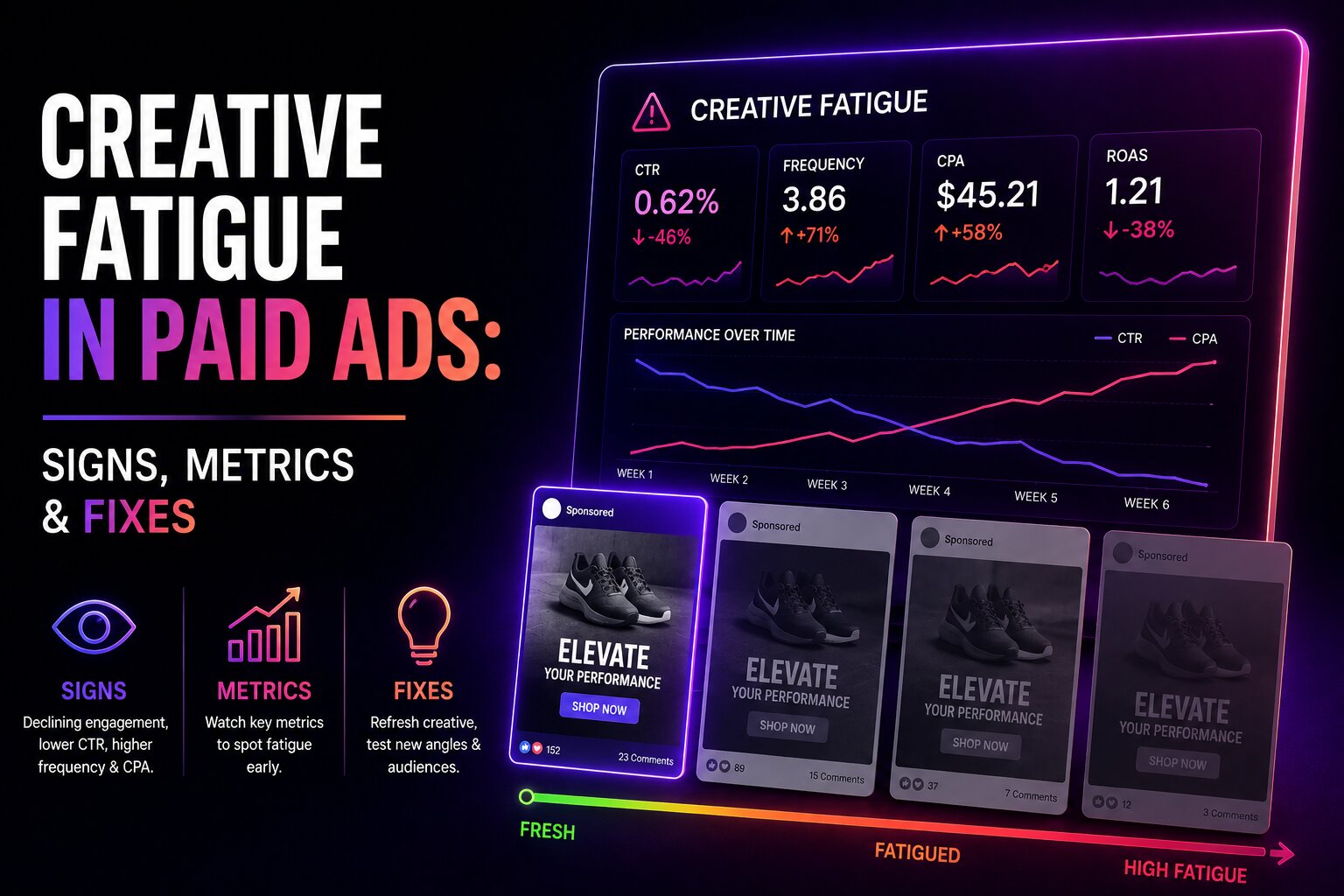
Your paid ad campaign can start strong and suddenly lose momentum. Click-through rates decline, costs rise, conversions slow down, and the same creatives that once generated consistent results stop producing the same return.
This is often a sign of creative fatigue.
Creative fatigue happens when your target audience sees the same advertisements too frequently and becomes less responsive to them. It can affect Meta Ads, Google Ads, TikTok Ads, LinkedIn Ads, and other paid advertising platforms. The good news is that creative fatigue is measurable and fixable.
By monitoring the right ad fatigue metrics, identifying early warning signs, and knowing when to refresh ad creatives, advertisers can protect campaign performance without constantly rebuilding their campaigns.
What Is Creative Fatigue in Ads?
Creative fatigue in ads occurs when an audience becomes less responsive to an advertisement after seeing it repeatedly. A creative may initially generate strong:
- Click-through rates
- Engagement
- Conversions
- Revenue
- Return on ad spend
But performance can decline as the audience becomes familiar with the message. The typical pattern looks like this:
New creative → strong engagement → repeated exposure → declining attention → lower CTR → higher costs → fewer conversions
Creative fatigue doesn’t necessarily mean the campaign, audience, or offer is bad. The creative may simply need to be refreshed.
What Causes Ad Fatigue?
Several factors can contribute to ad fatigue.
1. High audience frequency
The more frequently the same users see an advertisement, the greater the potential for fatigue.
2. Small audiences
Small audiences naturally receive repeated exposure faster than large audiences.
3. Limited creative variety
If you’re running only one or two advertisements, users may see the same message repeatedly.
4. Long campaign duration
Even strong creative can eventually lose effectiveness when it remains unchanged for too long.
5. Strong competition
Your audience isn’t only seeing your ads. Competitors are also competing for their attention.
6. Weak creative rotation
If poor-performing creatives aren’t replaced, the campaign can continue spending on advertisements that no longer resonate.
7 Signs Your Ads Are Experiencing Creative Fatigue
Knowing the signs early can help you intervene before performance deteriorates significantly.
1. CTR Is Declining
One of the clearest indicators of creative fatigue in ads is a declining click-through rate. Suppose your ad previously generated:
2.5% CTR
and gradually falls to:
1.2% CTR
That may indicate that users are becoming less interested in the advertisement. However, don’t assume fatigue based on CTR alone. Compare CTR with other metrics such as frequency, CPM, CPC, and conversion rate.
2. Frequency Is Increasing
Frequency measures the average number of times users have been exposed to your ad.
For example:
Week 1: 1.4 frequency
Week 2: 2.1 frequency
Week 3: 3.3 frequency
Week 4: 4.7 frequency
If frequency increases while CTR and conversions decline, the combination is a stronger indication of creative fatigue. There isn’t one universal frequency number that means an ad is fatigued. The appropriate level depends on:
- Campaign objective
- Audience size
- Industry
- Sales cycle
- Creative quality
- Retargeting vs. prospecting
- Campaign duration
Focus on trends, not a single threshold.
3. CPM Starts Rising
An increase in CPM can be another warning sign. However, CPM increases don’t automatically mean creative fatigue. CPM can rise because of:
Increased competition
Seasonal demand
Audience changes
Auction conditions
Placement changes
Creative quality
That’s why CPM should be evaluated alongside frequency and engagement. A particularly useful warning pattern is: Frequency ↑ + CTR ↓ + CPM ↑
When several metrics deteriorate at the same time, creative fatigue becomes a stronger possibility.
4. CPC Is Increasing
If your CTR declines while CPM remains stable or increases, your cost per click may rise.
For example:
Before
CPM: $10
CTR: 2.5%
CPC: approximately $0.40
After
CPM: $12
CTR: 1.2%
CPC: approximately $1.00
The audience isn’t clicking as frequently, making every click more expensive. This is why CPC is one of the useful ad fatigue metrics to monitor.
5. Conversion Rate Declines
A fatigued audience may still click your advertisement but become less likely to convert. This can happen when the user becomes less interested in the offer or the advertisement no longer creates enough urgency. Monitor:
Landing page conversion rate
Lead conversion rate
Purchase conversion rate
Cost per acquisition
Revenue per visitor
If CTR remains stable but conversion rate falls sharply, investigate your landing page and offer before blaming creative fatigue.
6. CPA Starts Increasing
A rise in cost per acquisition is one of the most important business-level warning signs.
For example:
CPA before: $30
CPA after: $55
If conversions have become more expensive while frequency has increased and CTR has declined, your creative may be contributing to the problem. CPA should be evaluated alongside your business’s acceptable acquisition cost.
7. ROAS Declines
For ecommerce campaigns, creative fatigue may eventually show up as declining ROAS.
You may see:
ROAS: 4.2x → 3.6x → 2.8x
This means the campaign is generating less revenue relative to advertising spend. However, ROAS can decline for many reasons, including:
- Higher CPM
- Lower conversion rate
- Lower average order value
- Higher product costs
- Weaker offers
- Seasonality
Don’t use ROAS alone to diagnose creative fatigue.
The Most Important Ad Fatigue Metrics to Track
A strong monitoring system combines several metrics rather than relying on a single number.
| Metric | What It Can Tell You |
| Frequency | How often users see the ad |
| CTR | Whether people still want to engage |
| CPM | Cost of reaching the audience |
| CPC | Cost of generating clicks |
| Conversion Rate | Whether traffic still converts |
| CPA | Cost of acquiring customers/leads |
| ROAS | Revenue efficiency |
| Engagement | Whether the creative still attracts attention |
The strongest warning signal
Look for multiple negative trends happening together.
For example:
Frequency ↑
CTR ↓
CPC ↑
CPA ↑
ROAS ↓
That combination is much more meaningful than any single metric changing.
How to Confirm Creative Fatigue
Before replacing an advertisement, compare its performance against its historical baseline.
Look at:
7-day performance
Useful for identifying recent changes.
14-day performance
Useful for identifying short-term trends.
30-day performance
Useful for understanding longer-term deterioration. Then compare: Current period vs. previous period and, where appropriate: Current period vs. launch performance
For example:
| Metric | Launch | Current | Change |
| CTR | 2.8% | 1.4% | ↓ 50% |
| CPM | $9 | $13 | ↑ 44% |
| Frequency | 1.5 | 4.2 | ↑ 180% |
| CPC | $0.32 | $0.93 | ↑ 191% |
| CPA | $25 | $52 | ↑ 108% |
This pattern provides much stronger evidence of fatigue than simply saying, “The ad has been running for a month.”
When Should You Refresh Ad Creatives?
There is no universal rule such as “replace every ad every 30 days.” The right time to refresh ad creatives depends on performance. Consider refreshing creative when you see:
- Sustained CTR decline
- Increasing frequency
- Rising CPC
- Increasing CPA
- Declining conversion rate
- Falling ROAS
- Lower engagement
- Audience saturation
The key word is sustained. Don’t replace a profitable advertisement simply because one day of performance was weak. Look for a meaningful trend.
How to Refresh Ad Creatives Without Starting Over
Refreshing your advertising doesn’t necessarily mean creating an entirely new campaign. Start by changing the creative concept.
1. Change the Hook
The first few seconds or first visual element can have a major impact on attention.
Instead of:
“Improve Your Marketing Results”
Try:
“Why Your Ads Stop Working After 30 Days”
The second version introduces a specific problem and creates curiosity.
2. Change the Visual
If you’re using the same product image repeatedly, test:
- Product demonstrations
- Lifestyle images
- Customer photos
- Short-form video
- Screenshots
- Before-and-after visuals
- Educational graphics
- UGC-style content
A different visual can make an existing offer feel new.
3. Change the Messaging Angle
Don’t simply rewrite the same headline. Test fundamentally different angles.
Problem angle
“Still Losing Leads From Slow Follow-Up?”
Benefit angle
“Turn More Leads Into Customers”
Proof angle
“Trusted by 2,000+ Businesses”
Education angle
“3 Reasons Your Leads Aren’t Converting”
Offer angle
“Book a Free Strategy Call”
These approaches can reach the same audience while appealing to different motivations.
4. Introduce User-Generated Content
UGC-style creative can provide a significant change from polished brand advertising.
Examples include:
- Customer testimonials
- Product demonstrations
- Customer reviews
- Founder videos
- Behind-the-scenes content
- Unboxing videos
- “How I use this” videos
The goal isn’t to make every advertisement look amateur. It’s to introduce a more authentic and varied creative experience.
5. Use Different Formats
If your campaign relies heavily on static images, introduce video. If you use polished product videos, test:
UGC
Testimonials
Short educational clips
Demonstrations
Motion graphics
Different formats can capture attention in different ways.
6. Refresh the Offer
Sometimes the creative isn’t the problem. The audience may simply have seen the offer too many times. Instead of changing only the advertisement, test:
Bundles
Limited-time promotions
Bonuses
Free consultations
Free shipping
New product combinations
Seasonal offers
A stronger offer can give your creative a new reason to attract attention.
Don’t Just Change the Headline
One of the most common mistakes in creative testing is making tiny changes and calling them new creatives.
For example:
Ad A:
“Get Better Marketing Results”
Ad B:
“Get Improved Marketing Results”
That’s not a meaningful creative test.
Instead, change the concept.
Creative A — Problem
“Why Your Paid Ads Stop Converting”
Creative B — Education
“5 Reasons Your Ad Costs Keep Rising”
Creative C — Social Proof
“How 500+ Businesses Improved Their Lead Flow”
Creative D — Demonstration
“Watch How This Process Works”
Now you’re testing different reasons for the audience to pay attention.
How Many New Creatives Should You Test?
The answer depends on your budget, audience size, campaign structure, and conversion volume. A small campaign may not need dozens of new advertisements at once. A practical approach is to introduce a manageable number of genuinely different concepts and allow enough time for meaningful data to accumulate.
For example:
Existing winners
Keep them running.
Weak performers
Consider replacing them.
New concepts
Introduce several distinct creative angles.
Then compare performance based on your campaign objective. The goal is not to maximize the number of ads. The goal is to maximize the number of useful creative learnings.
Creative Fatigue vs. Audience Fatigue
These two concepts are related but different.
Creative fatigue
The audience becomes tired of seeing the same advertisement. Solution: Refresh the creative.
Audience fatigue
The campaign has repeatedly reached much of the available audience. Solution: Consider expanding or changing the audience.
For example, if your frequency is rising rapidly because your target audience is extremely small, creating 20 new ads may not solve the problem. You may need to increase the size of the addressable audience.
Creative Fatigue vs. Offer Fatigue
Another important distinction is offer fatigue. Imagine you have been promoting:
“20% Off This Week” for six months.
Even if you continually create new advertisements, users may stop responding because the offer no longer feels compelling.
In this case:
New creative + same offer = potentially limited improvement
You may need to rethink the offer itself.
A Simple Creative Refresh Framework
Use this framework whenever performance begins to deteriorate.
Step 1: Identify the decline
Find the first metric that changed significantly.
Step 2: Check frequency
Determine whether the same audience is receiving excessive exposure.
Step 3: Compare creative performance
Identify which advertisements are declining and which remain strong.
Step 4: Keep proven winners
Don’t replace profitable ads simply because they’re old.
Step 5: Build new concepts
Create substantially different hooks, visuals, formats, and messages.
Step 6: Launch controlled tests
Avoid changing every campaign variable simultaneously.
Step 7: Measure the new creative
Compare CTR, CPC, conversion rate, CPA, and ROAS.
Step 8: Scale the winners
Increase investment in creative concepts that demonstrate strong results.
Creative Fatigue Monitoring Dashboard
A simple dashboard can make creative fatigue much easier to identify.
Track these metrics weekly:
| Metric | Healthy Signal | Warning Signal |
| Frequency | Stable | Rapid increase |
| CTR | Stable/increasing | Sustained decline |
| CPM | Stable | Significant increase |
| CPC | Stable | Increasing |
| Conversion Rate | Stable | Declining |
| CPA | Stable/decreasing | Increasing |
| ROAS | Stable/increasing | Declining |
| Engagement | Stable | Declining |
Don’t treat the “warning” column as a universal benchmark. Use your own historical performance as the baseline.
How Often Should You Refresh Ad Creatives?
There is no universal creative refresh schedule. Some campaigns may need new creative every few weeks. Others can run the same winning creative for months.
It depends on:
- Audience size
- Budget
- Frequency
- Campaign objective
- Industry
- Creative format
- Market competitiveness
- Sales cycle
High-spend campaigns targeting small audiences will generally reach fatigue faster than lower-spend campaigns with broad audiences. The better strategy is:
Refresh based on performance, not a calendar.
Final Thoughts
Creative fatigue in ads is a normal part of paid media. Even a highly successful advertisement can eventually lose its effectiveness as audiences see it repeatedly. The solution isn’t to constantly replace everything.
Instead, monitor the right ad fatigue metrics, identify meaningful performance trends, and refresh ad creatives when the data indicates that your audience is becoming less responsive. The strongest warning pattern is often a combination of:
Higher frequency + lower CTR + higher CPC + higher CPA + lower ROAS
When those signals appear together, it’s time to investigate creative fatigue. But remember that fatigue isn’t the only possible explanation. Rising competition, audience saturation, weaker offers, website problems, seasonality, and tracking issues can produce similar symptoms. The best advertisers don’t refresh creative simply because an ad is old. They refresh it because the data shows that the audience is ready for something new. That approach keeps creative testing strategic, protects campaign efficiency, and creates a continuous pipeline of new ideas without throwing away what already works.
