
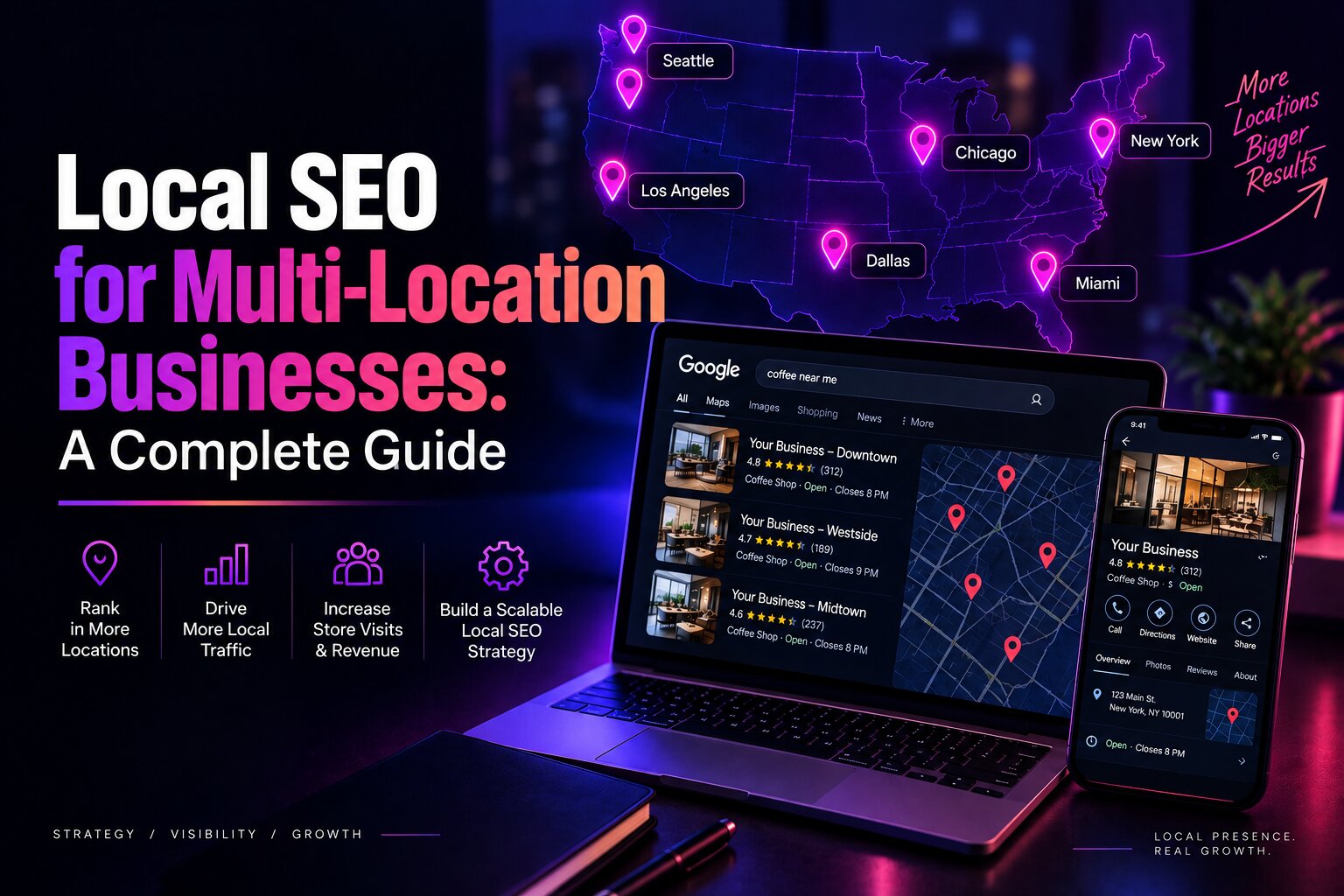
For a local business, ranking in Google Maps can be one of the most valuable sources of visibility in search. When someone searches for a nearby service, Google may display a map and a selection of local businesses before the traditional organic results. Appearing in this local pack can put a business directly in front of customers who are actively looking for what it offers.
The challenge is that Google Maps SEO becomes significantly harder in competitive cities. A business competing in a major market may be up against companies that have accumulated years of customer reviews, local backlinks, brand recognition, citations, and search visibility. Simply creating a Google Business Profile and adding a few keywords is unlikely to be enough to consistently outrank them.
Instead, businesses need to build a stronger overall local presence. That means making the business highly relevant to the searches it wants to appear for, maintaining accurate and trustworthy information, building genuine customer reviews, strengthening its website, and developing prominence within the local market.
In other words, ranking in Google Maps is not just about optimising a profile. It is about building a business that Google can confidently associate with a particular service, location, and search intent.
How Does Google Decide Which Businesses Rank in Google Maps?
Google’s local search results are primarily influenced by relevance, distance, and prominence. These three concepts provide a useful framework for understanding why one business may appear in the local pack while another does not.
Relevance
Relevance is about how closely a business matches what the searcher is looking for. Consider someone searching for “emergency dentist.” A dental practice that clearly provides emergency dental services is more relevant to that query than a general healthcare business.
This is why your Google Business Profile needs to accurately describe what your business actually does. Your primary category, secondary categories, services, website content, and other business information should all reinforce the same understanding of the business. Relevance does not mean adding every possible keyword to your profile. It means making the connection between your business and your target search intent clear.
Distance
Distance refers to how far the business is from the location associated with the search. For searches such as “coffee shop near me,” the searcher’s physical location is particularly important. For searches that include a specific city or neighbourhood, Google can use that location as part of its understanding of the query.
This is one reason businesses should be realistic about the geographic areas they target. You cannot simply optimise a profile for every major city and expect to rank there. For businesses with multiple legitimate locations, each location needs to establish its own local relevance.
Prominence
Prominence is essentially about how well-known and established a business is. This is where competitive Google Maps SEO becomes particularly interesting.
A business can have an accurate Google Business Profile but still struggle to outrank competitors that have stronger reputations, more reviews, better local links, and greater recognition across the web. Prominence can be supported by factors such as customer reviews, local mentions, relevant backlinks, citations, brand recognition, and the overall authority of the business’s online presence.
This is closely connected to the broader principles of EEAT and SEO. Building experience, expertise, authority, and trust is not simply about publishing more content; it also involves demonstrating credibility through real-world experience, reputable mentions, quality backlinks, customer feedback, and transparent business information.
Google Maps Rankings Are Not the Same as Organic Rankings
It is also important to distinguish Google Maps visibility from traditional organic rankings. A business might rank on the first page organically for a particular keyword but fail to appear prominently in the local pack. Conversely, a business with a strong local presence may perform particularly well in Maps even if its broader organic visibility is weaker.
The two areas overlap, but they should not be treated as exactly the same ranking system. A strong local SEO strategy therefore needs to support both the Google Business Profile and the website behind it.
Optimise Your Google Business Profile Properly
Your Google Business Profile is the foundation of your Google Maps presence, but optimisation should start with accuracy rather than keyword stuffing. Every important piece of information should accurately represent the real business. This includes the business name, address, phone number, website, opening hours, services, categories, and other applicable profile information. The business category is particularly important because it helps Google understand what type of business you operate. Your primary category should describe the core business, while additional categories should only be used when they genuinely apply.
For example, a digital marketing agency should not select unrelated categories simply because they appear to have search demand. Doing so can weaken the clarity of the business’s profile rather than improving it. The same principle applies to the business description and services. Explain what the business does in natural language and make the information useful to potential customers. Your profile should also remain current.
If your opening hours change, services are added, the business relocates, or other important details change, update the profile accordingly. An outdated profile creates friction for customers and can undermine confidence in the business. Photos are another opportunity to improve the profile’s usefulness. Instead of uploading a collection of generic stock images, show customers what they can actually expect. Depending on the business, this could include photographs of the premises, team, products, facilities, completed work, or services.
The objective is not to create an artificially “optimised” profile. It is to create a complete and trustworthy representation of the business.
Reviews Can Make a Major Difference in Competitive Markets
Imagine two businesses offering the same service in the same city. One has dozens of reviews and an established reputation. The other has only a handful of reviews despite having operated for several years. Even before looking at rankings, customers are likely to perceive the two businesses differently. Reviews therefore play an important role in local search and customer decision-making.
Businesses should build a process for consistently encouraging genuine customer feedback after successful interactions. This might involve providing customers with a convenient review link, following up after a completed service, or incorporating review requests into an existing customer communication process. The key word is genuine.
Buying reviews, manufacturing feedback, or offering inappropriate incentives for positive reviews can undermine the credibility of the business and create policy risks. Review management also should not stop once the review has been submitted. Responding to customers shows that the business is paying attention. Positive reviews can be acknowledged, while negative reviews can be addressed professionally and constructively.
There is also no need to turn every response into an SEO exercise. If a customer naturally mentions a service or location, a response can refer to it where appropriate. But forcing keywords such as “best dentist in Singapore” into every response can make the interaction look unnatural. The better approach is to treat reviews as part of reputation management and customer experience, not simply as another place to insert keywords.
Build the Local Signals That Support Your Google Business Profile
Your Google Business Profile does not exist in isolation. Google can encounter information about your business across your website, directories, publications, industry websites, review platforms, and other sources. The more consistent and credible these signals are, the easier it can be to understand the business.
One of the fundamentals is maintaining consistent name, address, and phone number (NAP) information across important business listings. This becomes particularly important when a company has moved locations, changed phone numbers, rebranded, or acquired another business.
An old directory listing with an outdated address may seem insignificant on its own, but businesses with a large online footprint can accumulate many conflicting references over time.
Local citations can help reinforce the relationship between your business and its location, but quality matters more than quantity. There is little value in submitting a business to hundreds of low-quality directories simply to create more listings.
A better approach is to prioritise reputable directories, industry platforms, local organisations, and websites that are genuinely relevant to the business. The same principle applies to backlinks. A relevant mention from a respected local publication or industry organisation can contribute far more to a business’s credibility than a large collection of unrelated links.
This reflects a broader SEO principle discussed in NxT Era’s EEAT and SEO guide: authority is built through credible expertise, relevant mentions, quality backlinks, and signals that demonstrate that a business can be trusted.
Your Website Still Matters for Google Maps SEO
One of the mistakes businesses make is treating their Google Business Profile and website as two separate SEO projects. They should support each other. Your website gives Google additional context about the business, its services, its expertise, and the locations it serves.
For example, if a business’s Google Business Profile identifies it as an SEO agency in Florida, its website should clearly communicate that same proposition.
Important service and location information should be easy for both users and search engines to understand. This can be reflected in page titles, headings, body content, internal links, structured data, and other on-page elements.
However, this does not mean every page needs to repeat the same city and service keyword. The goal is to create a website that comprehensively explains the business. For example, a local SEO agency might have:
- A core SEO service page
- A local SEO page
- Supporting educational content
- Case studies
- Industry-specific resources
- Location pages where genuinely useful
These pages can then reinforce one another through relevant internal links. That structure is consistent with the principles behind [content hubs and topic clusters], where interconnected content helps search engines understand the relationships between subjects and reinforces topical authority.
Be Careful When Creating Location Pages at Scale
Businesses operating in several cities may naturally want to create a page for every location. That can work—but only when each page provides genuine value. A common mistake is to create one template and replace the city name:
SEO Agency in Texas
becomes:
SEO Agency in Arizona
which becomes:
SEO Agency in New York
with almost everything else remaining identical.
That approach creates pages that provide little additional information to users.
NxT Era’s research on programmatic SEO in 2026 makes the same point: scalable pages can work when they satisfy a genuine search intent and provide meaningful differences, but mass-producing thin or near-identical pages is unlikely to create sustainable search visibility.
If a location genuinely deserves its own page, give users a reason to visit it. Include information that reflects the market, services, customers, team, facilities, or other legitimate characteristics of that location. The principle is simple: scale useful content, not duplicated pages.
Build Local Authority Beyond Your Own Website
In highly competitive cities, your website and Google Business Profile may not be enough to close the gap with established competitors. You also need to consider what happens outside your own properties.
Ask yourself:
Where is this business being mentioned?
A well-established local company may be referenced by newspapers, industry organisations, business associations, community websites, event pages, partner companies, and other trusted sources. Those references contribute to the broader perception of the business. Building this type of local authority does not require manipulating links. It can come from legitimate business activity.
A company might sponsor a relevant community event, collaborate with another local business, contribute expert commentary to a publication, participate in an industry association, or support a local initiative. These activities can create genuine opportunities for mentions, relationships, referral traffic, and backlinks.
Over time, they can help establish the business as a recognised participant in its local market. This is particularly valuable in competitive cities because prominence is difficult to manufacture. It generally needs to be earned through a combination of online and offline recognition.
Keep Your Google Business Profile Active and Accurate
Once your profile is optimised, it should not be forgotten. Businesses change over time. New services are introduced, opening hours change, products are added, staff or facilities change, and customers interact with the profile. Regularly reviewing the profile helps ensure that the information customers see remains accurate.
Businesses can also use available profile features to communicate useful updates, add relevant photographs, highlight services, and respond to customer interactions. The important distinction is between useful activity and activity for its own sake.
Publishing something simply because you believe Google rewards frequency is not a strong strategy. Instead, ask whether the update provides useful information to a potential customer. A new service, seasonal offering, event, facility, or important business announcement may be worth highlighting. A generic keyword-filled post published every week simply to “feed Google” is unlikely to provide the same value.
What About Businesses With Multiple Locations?
Businesses with several locations need to think about Google Maps SEO at the individual-location level. Each legitimate location should have accurate information and its own appropriate Google Business Profile where eligible.
The website should also make it easy for users to understand where each location operates and what services are available there. The important thing is to avoid treating every location as a clone of the others.
A national or international brand can maintain consistent branding while still allowing each location to demonstrate genuine local relevance. This is where a scalable SEO framework becomes useful. Centralised standards can govern things such as business information, technical SEO, internal linking, and profile management, while location-level information can reflect genuine differences between markets. For businesses managing many locations, this approach provides a better balance between consistency and local relevance.
Google Maps SEO Mistakes That Can Hold You Back
Some businesses spend considerable time trying to improve their Maps rankings while accidentally creating problems elsewhere.
One of the most common mistakes is keyword stuffing the business name. The name should reflect the real-world business rather than being modified to include target keywords.
Another is selecting irrelevant categories simply because they appear valuable.
Businesses should also avoid creating fake locations or duplicate profiles in an attempt to expand their geographic reach. If the business does not genuinely qualify for a location, creating a profile for it is not a sustainable SEO strategy.
Review manipulation is another problem. Buying reviews or artificially generating positive feedback can damage the reputation businesses are trying to build.
On the website side, thin location pages can create another problem. Publishing dozens of nearly identical pages does not automatically create local authority.
And finally, businesses often forget the basics. An outdated phone number, incorrect opening hours, old address, or neglected review profile can undermine an otherwise strong local SEO campaign.
How to Measure Whether Your Google Maps Strategy Is Working
A higher Maps ranking is useful, but it should not be the only metric you track. The ultimate purpose of local SEO is to generate meaningful business outcomes.
Start by monitoring visibility for the searches that matter to the business. Track local pack and Maps performance for important service and location combinations, while remembering that local results can vary based on the searcher’s location.
Then look beyond rankings.
- Are people calling the business?
- Are they visiting the website?
- Are they requesting directions?
- Are reviews increasing?
- Is the average rating improving?
- Are more people interacting with the Google Business Profile?
These metrics help determine whether greater visibility is translating into actual customer activity.
Competitor comparison is also valuable. If another business consistently appears above you, investigate the underlying differences instead of simply looking at its ranking. Perhaps it has significantly more genuine reviews. Maybe it has stronger local mentions, more relevant backlinks, a more authoritative website, or a better-established brand. The objective is to identify the gap in local authority, then build a strategy to close it.
A Practical Google Maps SEO Strategy
For businesses competing in difficult markets, the process can be simplified into a series of ongoing priorities.
First, audit the Google Business Profile and make sure the fundamental information is accurate. Review the business category, services, description, contact information, hours, photographs, and other relevant details.
Next, look at the website. Make sure it clearly communicates the services offered, the areas served, and the reasons customers should trust the business.
Then assess the business’s reputation. How many genuine reviews does it have? How does its rating compare with competitors? Are customers receiving responses?
After that, examine the broader local footprint. Check important citations, identify inconsistent business information, and look for opportunities to earn relevant local backlinks and mentions.
Finally, look at the competitive landscape.
You do not need to copy every tactic your competitors use. Instead, determine what makes the strongest competitors prominent and identify the areas where your business has a genuine opportunity to become stronger.
Then repeat the process.
Google Maps SEO is not a one-time optimisation exercise. Local markets change, competitors improve, businesses open and close, reviews accumulate, and search behaviour evolves.
The businesses that continue monitoring and improving their local presence are more likely to maintain visibility over time.
Google Maps SEO Is Becoming Part of a Bigger Search Strategy
There is another reason businesses should think beyond the Google Business Profile. Search is becoming increasingly interconnected. Google continues to introduce AI-driven experiences, while platforms such as ChatGPT are changing how people discover businesses, products, and information. That means businesses are increasingly being evaluated across a broader digital ecosystem rather than through a single ranking position.
NxT Era’s analysis of [how brands are getting mentioned inside ChatGPT answers] highlights several signals that can contribute to brand visibility in AI-generated answers, including consistent branding, authoritative backlinks, quality content, and positive online reputation.
Similarly, Google’s AI search experiences are placing greater emphasis on authority, structured information, content depth, and recognisable entities. For a local business, this reinforces an important principle: Do not build your online presence solely to rank in Google Maps. Build it so that search engines and AI systems can clearly understand who you are, what you do, where you operate, and why customers should trust you. That broader strategy can support visibility across traditional organic search, Google Maps, AI-powered search, and other discovery experiences.
Conclusion
Ranking in Google Maps in a competitive city is not about finding a single optimisation trick. It is about building a stronger local presence than the businesses you are competing against.
That starts with a complete and accurate Google Business Profile, but it does not end there. Reviews, local citations, backlinks, website quality, relevant content, brand mentions, and customer experience all contribute to the credibility and prominence of a business.
The three core concepts—relevance, distance, and prominence—provide a useful way to think about local search. You need to be relevant to the search, legitimately connected to the location, and recognised as a credible business within the market.
Most importantly, focus on building authority rather than chasing shortcuts. A business with genuine customer reviews, accurate information, useful content, strong local relationships, and a credible reputation has a much stronger foundation than one relying on keyword stuffing, fake locations, or mass-produced pages.
And as search becomes increasingly influenced by AI, that foundation becomes even more valuable. The goal is no longer simply to get into the Google Maps top three. The goal is to become one of the most relevant, trusted, and recognised businesses in your local market.
